


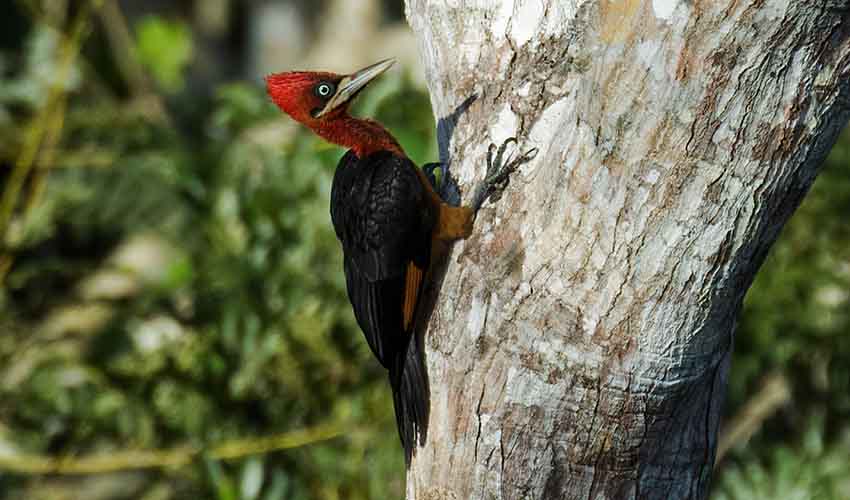
You can find this striking bird in almost every mainland South American country except Argentina, Chile, Paraguay, and Uruguay. It is related to some of the world’s largest woodpeckers and measures about twelve to fourteen inches long, weighing just half a pound. The bird thrives in many tropical places, from tall rainforests and misty cloud forests to open woodlands near rivers. Its name, taken from Latin words meaning “red” and “necked,” points to its most noticeable feature. Seeing this bird in the wild is a memorable moment for any nature lover.
The red-necked woodpecker stands out from its relatives because of its dark feathers and bold markings. Unlike some woodpeckers that are mostly red, this bird has a black or brownish-black back and wings. Its underparts are bright red on the chest, fading to a cinnamon-colored belly. You can tell males and females apart by looking at their heads. Males have a fully red head and neck with a small black-and-white spot near the ears. Females have a wide white stripe bordered with black running from the bill down the side of the head. Some subspecies also have chestnut-colored wing panels, making them easier to spot among other similar woodpeckers.
Besides its striking colors, the red-necked woodpecker has interesting behaviors. These birds are active foragers and often search for food in pairs or small family groups, moving from the middle of the forest up to the treetops. They use their long, ivory-colored beaks to hammer and peel bark, looking for beetle and moth larvae. This helps keep the forest healthy. Instead of singing, they make a loud, rhythmic “double-rap” sound that echoes through the trees, along with a sharp, nasal call. They live in their home territory all year, acting as lively caretakers of the tropical forest.
Distribution
 Bolivia
 Brazil
 Colombia
 Ecuador
 French Guiana
 Guyana
 Peru
Peru Suriname
 Venezuela
Anything we've missed?
Help us improve this page by suggesting edits. Glory never dies!
Suggest an editGet to know me
Terrestrial / Aquatic
Altricial / Precocial
Polygamous / Monogamous
Dimorphic (size) / Monomorphic
Active: Diurnal / Nocturnal
Social behavior: Solitary / Pack / Herd
Diet: Carnivore / Herbivore / Omnivore / Piscivorous / Insectivore
Migratory: Yes / No
Domesticated: Yes / No
Dangerous: Yes / No




