


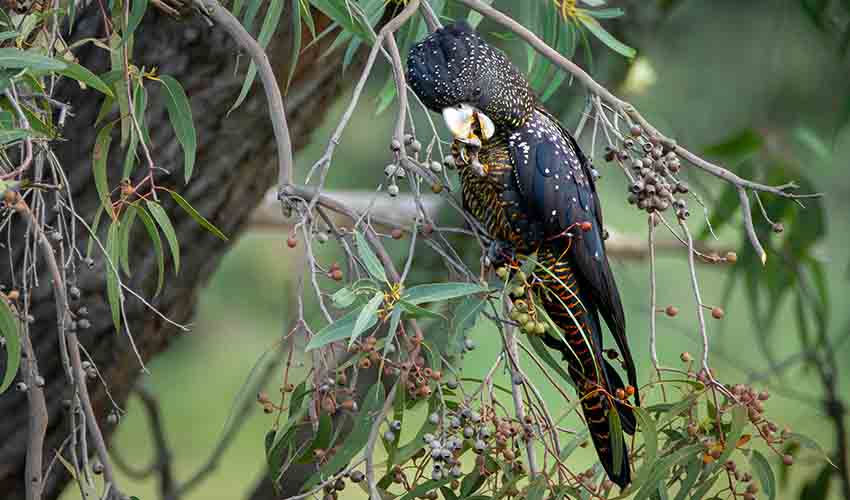
One of Australia’s most iconic and powerful parrots, known for its dramatic coloring, large size, and commanding presence. Its plumage is mostly deep black, creating a striking contrast with the bright red panels on the tail of adult males. Females and young birds display orange or yellow markings with dark spots instead of solid red, adding subtle variation within the species. The bird’s broad wings, long tail, and heavy, curved beak give it a strong, rugged appearance. When flying, its slow, steady wingbeats and loud calls make it easy to recognize even from a distance.
This cockatoo occupies a wide range of habitats across Australia, including woodlands, savannas, grasslands, and forest edges. It is highly adaptable and can survive in both arid and more temperate regions. The red-tailed black cockatoo feeds on a variety of seeds, nuts, fruits, and sometimes insects. Using its powerful beak, it cracks open tough seed pods and cones, often holding food with one foot while eating. Its feeding habits can leave clear signs behind, such as chewed seed pods scattered beneath trees, marking areas where the birds have been foraging.
Red-tailed black cockatoos are social birds and are often seen in pairs, family groups, or large flocks, especially outside the breeding season. They are highly vocal, producing loud, rolling calls that carry far across open landscapes. Mated pairs form strong, long-term bonds and may stay together for life. During the breeding season, they nest in large hollows of old trees, often returning to the same nesting sites year after year.
What sets the red-tailed black cockatoo apart from other cockatoos is its combination of size, adaptability, and cultural significance. It is one of the most widespread black cockatoos in Australia, yet it remains deeply connected to specific habitats that provide suitable nesting trees and food sources.
Distribution
 Australia
Anything we've missed?
Help us improve this page by suggesting edits. Glory never dies!
Suggest an editGet to know me
Terrestrial / Aquatic
Altricial / Precocial
Polygamous / Monogamous
Dimorphic (size) / Monomorphic
Active: Diurnal / Nocturnal
Social behavior: Solitary / Pack / Flock
Diet: Carnivore / Frugivore / Omnivore / Piscivorous / Insectivore
Migratory: Yes / No
Domesticated: Yes / No
Dangerous: Yes / No




