


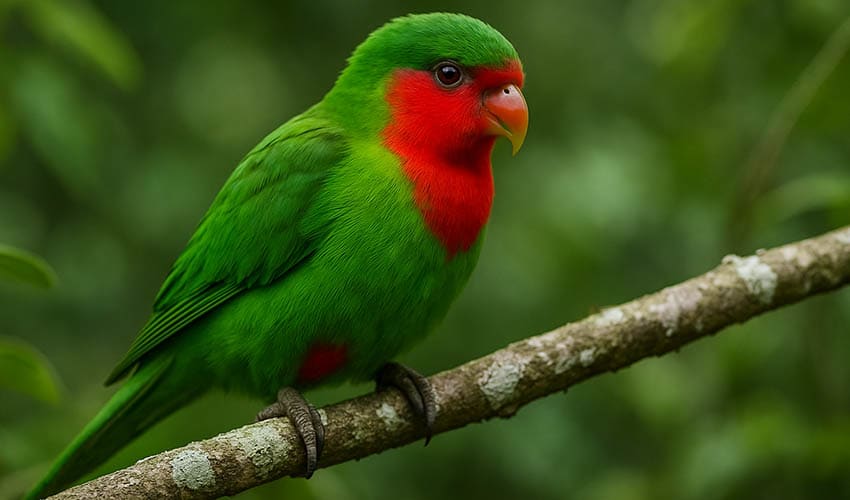
The Red-throated Lorikeet (Vini amabilis, formerly Charmosyna amabilis) is a tiny, brilliantly colored parrot found only in the forests of Fiji, and one of the most critically endangered bird-species on the planet. Both sexes are generally bright green, but they display vivid red cheeks, throat and thighs, with the throat often bordered by a thin yellow line — a striking combination that gives the bird its name. Young birds are similar, but with less intense red plumage and a brownish or orange bill rather than the bright orange of adults.
Historically, the Red-throated Lorikeet was found on several islands, including Viti Levu, Taveuni, Ovalau and possibly Vanua Levu, inhabiting montane and lowland rainforests ranging from around 500 m elevation or more. It is a specialist of flowering trees and shrubby forest habitat, feeding primarily on nectar, pollen and soft fruits, with occasional insects. Like other lorikeets, it has a brush-tongue adapted to extract nectar from flowers. Its behavior is fast and agile — flitting among canopy branches, calling with short, high-pitched squeaks, and darting between blossom and fruit.
Sadly, the species is now classified as Critically Endangered and may even be extinct in the wild — the last confirmed sighting was in 1993, and multiple targeted surveys since then have failed to locate any definite individuals. The population, if any remains, is likely very small and confined to remote forest pockets. The decline has been driven by massive habitat loss, predation by introduced black rats, feral cats and small Indian mongooses, and possibly by competition from invasive bird species and changes in forest flowering patterns. Because the species depends on mature native forest with specific flowering trees, the destruction of that habitat has had outsized impact.
Distribution
 Fiji
Fiji Official estimate
Anything we've missed?
Help us improve this page by suggesting edits. Glory never dies!
Suggest an editGet to know me
Terrestrial / Aquatic
Altricial / Precocial
Polygamous / Monogamous
Dimorphic (size) / Monomorphic
Active: Diurnal / Nocturnal
Social behavior: Solitary / Pack / Herd
Diet: Carnivore / Folivore / Omnivore / Piscivorous / Insectivore
Migratory: Yes / No
Domesticated: Yes / No
Dangerous: Yes / No




