


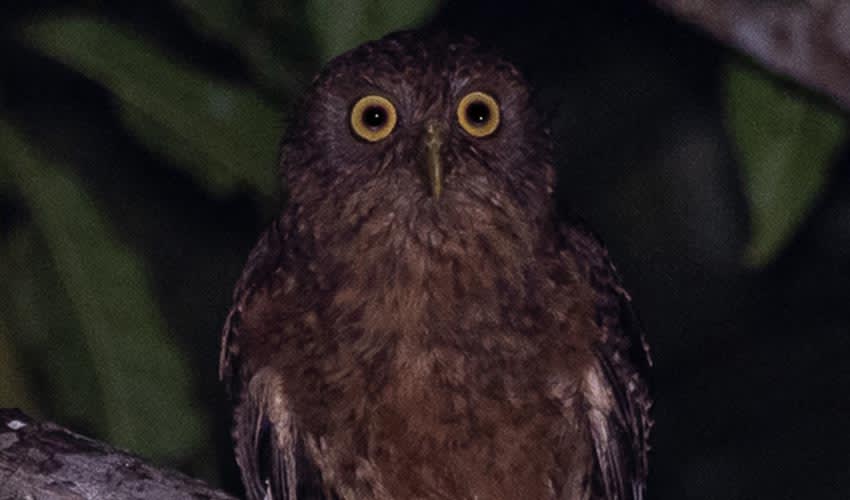
Like many island owls, it carries an air of mystery simply because of how limited its world is. Nowhere else on Earth does this bird naturally occur. It is a compact, round-headed owl with warm brown feathers, fine pale streaking, and a neat, alert expression. At first glance, it may look similar to other Philippine boobooks, but careful observers notice its slightly different face pattern, size, and overall coloration. Its yellow eyes shine brightly at night, and when a flashlight catches them, they glow like two small lanterns peering out of the forest.
For many years, the Romblon boobook was not even recognized as a distinct species. It was once grouped together with other hawk-owls in the Philippines under a broader label. Over time, scientists realized that owls living on different islands had distinct voices and features. The Romblon birds, in particular, had calls and characteristics that didn’t quite match those of nearby populations. As a result, they were eventually recognized as a separate species. This “promotion” to full species status makes the Romblon boobook a good example of how islands can shape wildlife in unique directions, turning what once seemed like the same bird into several different ones.
In daily life, the Romblon boobook behaves much like other small forest owls. It is mainly active at night, when it becomes an efficient and silent hunter. From a hidden perch, it scans for movement and listens carefully for the sounds of insects or small animals. With a quick, quiet swoop, it drops down to catch prey, often returning to the same branch to eat. Its diet probably includes large insects, small lizards, and other small creatures common in tropical forests. During the day, it tends to stay well hidden, roosting in thick foliage where its brown, streaked feathers help it blend in perfectly with bark and leaves.
Distribution
 Philippines
 Official estimate
Anything we've missed?
Help us improve this page by suggesting edits. Glory never dies!
Suggest an editGet to know me
Terrestrial / Aquatic
Altricial / Precocial
Polygamous / Monogamous
Dimorphic (size) / Monomorphic
Active: Diurnal / Nocturnal
Social behavior: Solitary / Pack / Herd
Diet: Carnivore / Herbivore / Omnivore / Piscivorous / Insectivore
Migratory: Yes / No
Domesticated: Yes / No
Dangerous: Yes / No




