


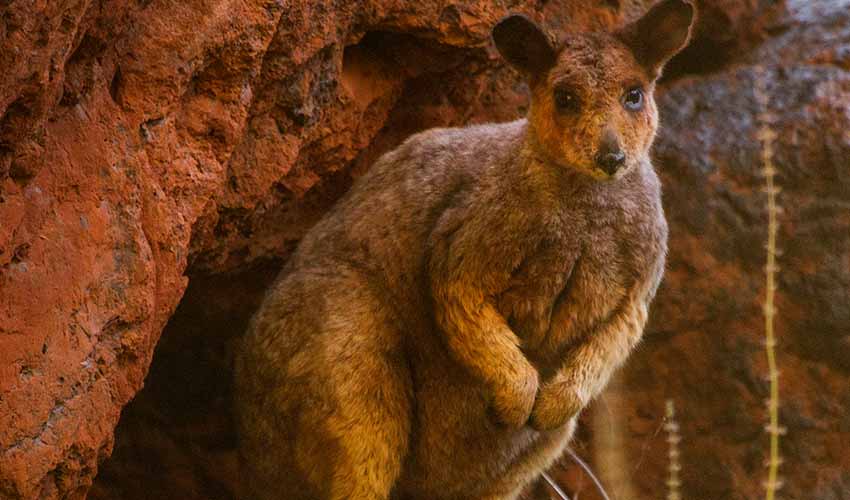
One of the largest rock-wallabies, with a sturdy body, powerful back legs, and a long tail that works like a balance beam when it hops across ledges. Its coloring is especially distinctive: the coat is mostly golden-brown, but the neck and shoulders can carry a gray wash that sometimes seems to shine with a faint purple tint in certain light, like a subtle “oil-slick” sheen on fur. During the day, it retreats into cool caves, cracks, and shaded rock piles to escape heat, then becomes more active at night when it can move out to feed in safer, cooler conditions.
While many rock-wallabies are smaller and occur in patchy pockets across Australia, this species is tied to the Pilbara and nearby rocky country, including parts of the Dampier Archipelago. Even more interesting, island populations tend to be smaller than their mainland relatives, giving the species a built-in “mini vs. maxi” story depending on where you find it. If you’re trying to picture it among its cousins, think: big-bodied rock-wallaby, warm golden tones, and that unusual gray-to-purple look around the neck that can make it stand out even in a genus known for subtle patterns.
Its daily life is a careful balance between food and safety. At night, it ventures beyond its rocky refuge to graze on green shoots, grasses, and other plants from nearby flats, often keeping close enough to the rocks that it can dash back if alarmed. Rocks aren’t just scenery—they’re a defense system. A wallaby that knows every crack and overhang can disappear in a heartbeat, leaving predators staring at an empty slope. Unlike animals that dig burrows, this species relies on the “architecture” of the landscape: caves, crevices, cliff collapses, and boulder piles become ready-made bedrooms and escape routes. It also tends to need water access and foraging areas close to its refuge, which helps explain why it favors certain rocky zones over others.
Distribution
 Australia
Anything we've missed?
Help us improve this page by suggesting edits. Glory never dies!
Suggest an editGet to know me
Terrestrial / Aquatic
Altricial / Precocial
Polygamous / Monogamous
Dimorphic (size) / Monomorphic
Active: Diurnal / Nocturnal
Social behavior: Solitary / Pack / Herd
Diet: Carnivore / Herbivore / Omnivore / Piscivorous / Insectivore
Migratory: Yes / No
Domesticated: Yes / No
Dangerous: Yes / No




