


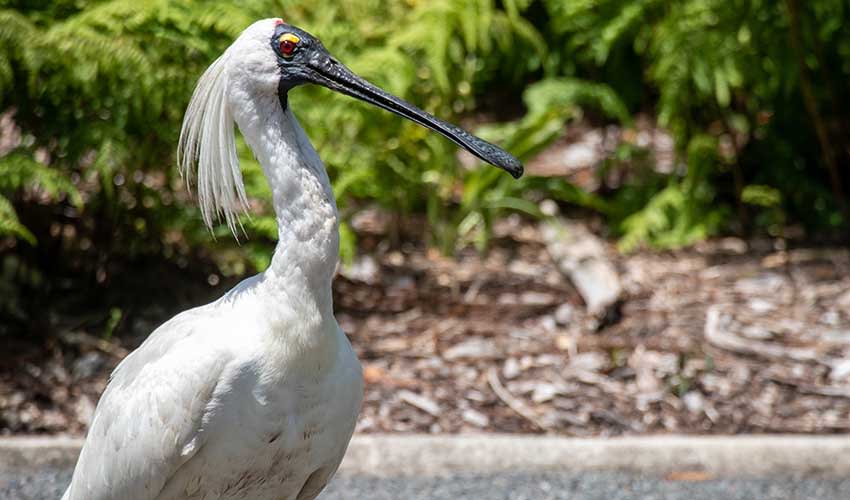
A striking white waterbird found in Australia, New Zealand, and nearby regions. It is best known for its long, flat bill, which widens at the tip like a spoon. This unusual bill makes it very different from birds such as herons, egrets, and storks, which usually have pointed bills for stabbing or grabbing prey. The royal spoonbill feeds in a special way: it walks slowly through shallow water while sweeping its bill from side to side. When tiny fish, shrimp, insects, or other small water animals touch the bill, it snaps shut quickly. This gives the bird a very clever hunting style, especially in muddy water where seeing prey is difficult.
One thing that makes the royal spoonbill different from the yellow-billed spoonbill is its darker bill and more elegant breeding appearance. The royal spoonbill has a black, spoon-shaped bill, black legs, and a clean white body. During the breeding season, it becomes even more impressive, growing long, soft feathers on its back and neck. These feathers form a beautiful crest that gives the bird a “royal” look, which is where its name comes from. It may also show yellowish patches on the face during this time. Compared with the plainer yellow-billed spoonbill, the royal spoonbill often looks more dramatic and fancy, especially when displaying or nesting.
The royal spoonbill lives in wetlands, estuaries, mudflats, lakes, rivers, swamps, and shallow coastal waters. It is often seen feeding alone or in small groups, walking with slow, careful steps. Its feeding motion can look almost like it is sweeping the water with a strange white broom. This side-to-side movement is not random; it helps the bird cover more ground and detect hidden prey. Because its bill is sensitive, the royal spoonbill does not always need clear water to find food. This makes it a very skilled wetland hunter.
Distribution
 Australia
 East Timor
 Indonesia
 New Caledonia
 New Zealand
 Papua New Guinea
Anything we've missed?
Help us improve this page by suggesting edits. Glory never dies!
Suggest an editGet to know me
Terrestrial / Aquatic
Altricial / Precocial
Polygamous / Monogamous
Dimorphic (size) / Monomorphic
Active: Diurnal / Nocturnal
Social behavior: Solitary / Pack / Flock
Diet: Carnivore / Herbivore / Omnivore / Piscivorous / Insectivore
Migratory: Yes / No
Domesticated: Yes / No
Dangerous: Yes / No




