


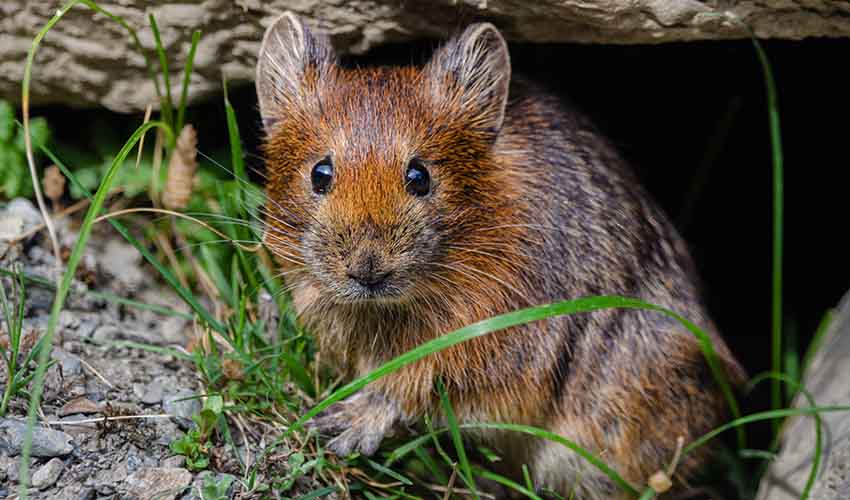
A small, tailless rabbit relative that looks like a plush, rounded “mini-hare” built for life on steep Himalayan slopes. Its ears are short and rounded, its legs are compact, and it moves by quick scurries and sudden stops rather than long hops. The most recognizable detail is its coloring: many individuals have a warm chestnut or rusty head and shoulders, while the rest of the body shifts into a mix of gray and reddish-brown that matches weathered rock and dry alpine plants. Seen from a distance, it can resemble a little lump of earth that suddenly comes alive.
What distinguishes Royle’s pika from other pikas is its “just-right” Himalayan niche. In the same mountains, you can find other pikas that stick to harsher, higher, more exposed rock fields, but Royle’s pika often lives a bit lower and in slightly greener, moister places—open rocky slopes mixed with shrubs, and even forested areas like rhododendron, spruce, or deodar where rocks and roots create plenty of hiding spaces. Instead of digging elaborate burrows like some grassland pikas, it usually relies on ready-made gaps: cracks in stone heaps, spaces under fallen logs, and cavities around roots. That choice shapes its personality: it is a master of vanishing. One second it’s perched like a lookout, the next it slips into a slit in the rocks that you didn’t even notice was there.
Royle’s pika also stands out in how it manages daily life in a place where the sun can be both a gift and a problem. Many people expect small mountain animals to be busy all day, but this pika often avoids the hottest hours, feeding more at cooler times like early morning and late afternoon. That schedule isn’t laziness—it’s temperature strategy. Its diet is mostly plants, and it nibbles whatever is available in its patch, from tender greens to tougher bits when choices shrink.
Distribution
 China
China India
India Nepal
Nepal Pakistan
Anything we've missed?
Help us improve this page by suggesting edits. Glory never dies!
Suggest an editGet to know me
Terrestrial / Aquatic
Altricial / Precocial
Polygamous / Monogamous
Dimorphic (size) / Monomorphic
Active: Diurnal / Nocturnal
Social behavior: Solitary / Pack / Herd
Diet: Carnivore / Herbivore / Omnivore / Piscivorous / Insectivore
Migratory: Yes / No
Domesticated: Yes / No
Dangerous: Yes / No




