


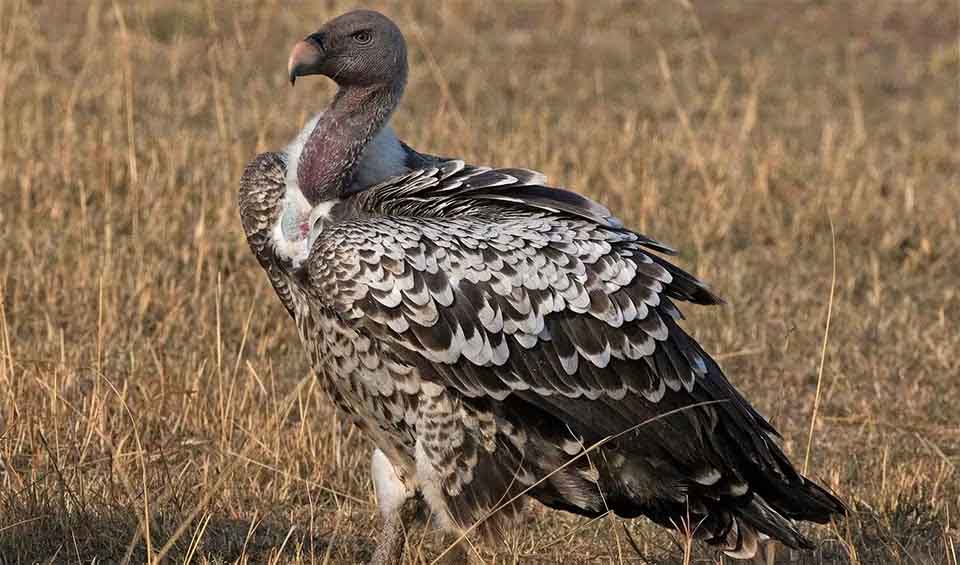
A Rüppell’sstriking and sociable bird of prey that inhabits the vast skies and open landscapes of sub-Saharan Africa. Named in honor of the German naturalist Eduard Rüppell, these vultures are a sight to behold with their majestic appearance and fascinating behaviors.
One of the most notable characteristics of Rüppell’s vulture is its social nature. Often seen congregating in groups, these vultures engage in silent gatherings, punctuated only by occasional vocalizations, particularly when scavenging on carcasses. Their communal feeding behavior is essential for their survival, as it allows them to efficiently locate and consume carrion, playing a crucial role in the ecosystem’s nutrient cycling process.
Despite their formidable appearance, Rüppell’s vultures possess unique adaptations for their scavenging lifestyle. Their bodies are adorned with a dense layer of downy feathers, providing insulation and protection from the elements. Interestingly, while their bodies are covered in feathers, their heads and necks are bare, which helps to prevent bacterial buildup when feeding on carcasses.
During moments of excitement or displays of dominance, the skin on their necks can flush bright red, adding to their already impressive appearance. This visual cue serves as a signal to other vultures, indicating their social status within the group hierarchy.
Rüppell’s vultures are primarily scavengers, feeding on the remains of large animals such as ungulates. Contrary to popular misconceptions, scavenging requires considerable energy and effort, as vultures must locate, assess, and compete to access carcasses. Despite their vital ecological role, these vultures face numerous threats, including habitat loss, poisoning from ingesting contaminated carcasses, and human persecution.
The decline in Rüppell’s vulture populations has raised concerns among conservationists, leading to efforts to protect and conserve these magnificent birds. Conservation initiatives focus on addressing the underlying causes of population decline, including habitat degradation, reducing human-wildlife conflict, and implementing measures to mitigate the impacts of poisoning.
Distribution
 Algeria
 Benin
Benin Botswana
 Burkina Faso
 Burundi
 Cameroon
 Central Af. Rep.
 Chad
Chad Côte D’ivoire
 DR Congo (Kinshasa)
 Djibouti
 Egypt
Egypt Eritrea
 Ethiopia
 Official estimate
 Gambia
 Ghana
Ghana Gibraltar
 Guinea-Bissau
 Guinea
 Kenya
Official estimate
Kenya
Official estimate
 Lesotho
 Malawi
 Mali
Mali Mauritania
 Morocco
 Mozambique
 Namibia
 Niger
Niger Nigeria
 Portugal
 Rwanda
 Saudi Arabia
 Senegal
 Sierra Leone
 Somalia
 South Africa
 South Sudan
 Spain
Spain Sudan
Official estimate
Sudan
Official estimate
 Tanzania
Official estimate
Tanzania
Official estimate
 Togo
Togo Uganda
 Zambia
 Zimbabwe
Anything we've missed?
Help us improve this page by suggesting edits. Glory never dies!
Suggest an editGet to know me
Terrestrial / Aquatic
Altricial / Precocial
Polygamous / Monogamous
Dimorphic (size) / Monomorphic
Active: Diurnal / Nocturnal
Social behavior: Solitary / Pack / Herd
Diet: Carnivore / Herbivore / Omnivore / Piscivorous / Insectivore
Migratory: Yes / No
Domesticated: Yes / No
Dangerous: Yes / No





