


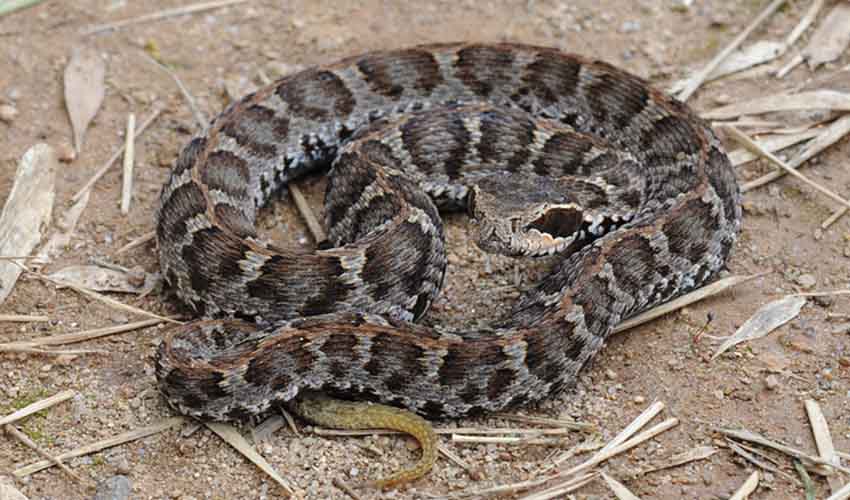
A compact but powerful snake that perfectly embodies the phrase “small but mighty.” Found across China, Korea, and parts of eastern Russia, this viper is a master of stealth and precision—a patient ambush predator that relies on camouflage, patience, and a lightning-fast strike. Despite its modest size, it’s one of East Asia’s most fascinating venomous snakes, adapted to survive in some of the region’s harshest environments.
As its name suggests, it has a noticeably short, thick tail compared to other snakes, giving its body a stocky and muscular appearance. Its coloration varies depending on its habitat but usually features shades of gray, brown, or olive, patterned with darker crossbands or blotches that help it blend into forest floors, rocky slopes, and grasslands. Its triangular head—a classic viper feature—is distinct from its neck, and its heat-sensing pits between the eyes and nostrils allow it to detect warm-blooded prey even in total darkness.
This viper is primarily nocturnal and ambushes its prey, which consists mainly of small mammals, frogs, and lizards. It relies heavily on stealth, remaining motionless until its prey comes within range before striking with incredible speed. Its venom is hemotoxic, meaning it targets blood and tissue, immobilizing prey quickly. Though venomous, it’s generally shy and avoids humans, striking only when threatened or cornered. Its bite can be painful and medically significant but is rarely fatal with proper treatment.
The short-tailed pit viper has an impressive geographic range, inhabiting mountainous and temperate regions, including cold climates where few snakes thrive. It can be found from lowland forests to elevations of over 2,000 meters (6,500 feet). During colder months, it hibernates in burrows or rock crevices, sometimes sharing dens with other snakes. When spring arrives, it emerges to hunt and breed.
Distribution
 China
China Korea
Korea North Korea
 Russia
Anything we've missed?
Help us improve this page by suggesting edits. Glory never dies!
Suggest an editGet to know me
Terrestrial / Aquatic
Altricial / Precocial
Polygamous / Monogamous
Dimorphic (size) / Monomorphic
Active: Diurnal / Nocturnal
Social behavior: Solitary / Pack / Herd
Diet: Carnivore / Herbivore / Omnivore / Piscivorous / Insectivore
Migratory: Yes / No
Domesticated: Yes / No
Dangerous: Yes / No




