


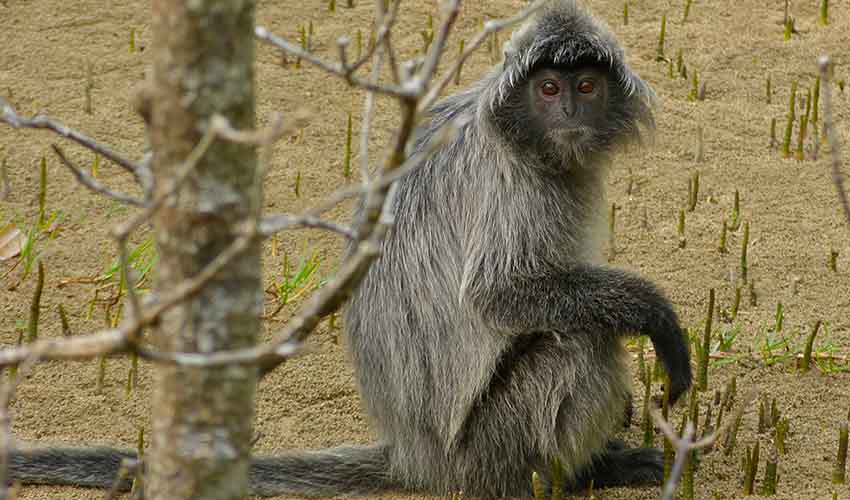
A quiet, tree-loving primate known for its silvery-gray fur and gentle face. It lives in the dense tropical forests, mangroves, and coastal areas of countries like Malaysia, Indonesia, and Brunei. These monkeys belong to the colobine group—a branch of Old World monkeys known for their leaf-heavy diet and complex stomachs. What makes the Silvery lutung especially fascinating is not just its silvery coat, but its social habits, peaceful nature, and surprising baby colors.
Adult Silvery lutungs have long, sleek gray fur that gives them a soft, silvery shimmer—hence their name. Their faces are black and framed by spiky hair that gives them a somewhat “punk rock” appearance, especially when paired with their bright, intelligent eyes. They are medium-sized monkeys with tails often longer than their bodies. These tails help them balance as they move gracefully through the treetops, where they spend most of their time.
One of the most amazing things about Silvery lutungs is their babies. When they’re born, infant lutungs don’t look anything like the adults. Instead, they are covered in bright orange fur and have pale faces. This color change is thought to help adults keep track of the young more easily in the forest, especially since multiple females in a group help care for them. Over the course of a few months, the orange coat slowly fades into the silvery gray of adulthood.
Their diet is mainly made up of leaves, along with fruits, seeds, and flowers. Because leaves are tough to digest, Silvery lutungs have specialized stomachs with multiple chambers, much like cows. These stomachs help break down tough plant fibers through fermentation, allowing the monkeys to get the most nutrition out of their leafy meals. This digestive system is part of what keeps them so well adapted to life in the canopy.
Distribution
 Brunei
 Indonesia
 Malaysia
Anything we've missed?
Help us improve this page by suggesting edits. Glory never dies!
Suggest an editGet to know me
Terrestrial / Aquatic
Altricial / Precocial
Polygamous / Monogamous
Dimorphic (size) / Monomorphic
Active: Diurnal / Nocturnal
Social behavior: Solitary / Pack / Group
Diet: Carnivore / Folivore / Omnivore / Piscivorous / Insectivore
Migratory: Yes / No
Domesticated: Yes / No
Dangerous: Yes / No




