


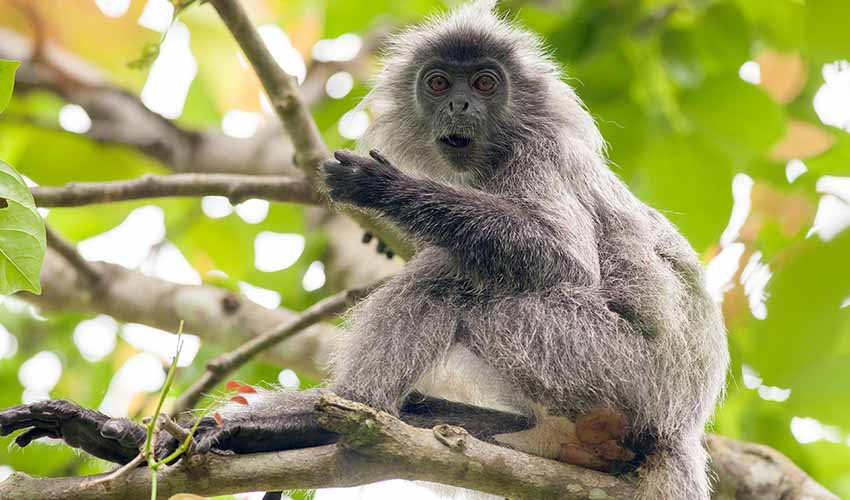
A striking and graceful leaf monkey found mainly in Peninsular Malaysia, especially around Selangor, where it gets its name. Long mistaken for the more widespread Silvery lutung, this species was only recently recognized as genetically distinct. It inhabits mangrove forests, coastal woodlands, riverine forests, and lowland tropical forests—habitats where its silvery coat and quiet demeanor blend seamlessly into the surrounding greenery.
The appearance of the Selangor silvered langur is both eye-catching and subtly beautiful. Adults have long, soft, gray or silvery fur that grows in smooth layers down their bodies, giving them a shimmering, almost metallic sheen when light hits their coat. Their faces are dark and framed by spiky, swept-back hair that resembles a natural crown or crest. Their long limbs and extremely long tail—often longer than their body—make them expert climbers, perfectly adapted to life in the forest canopy. When they leap between branches, their bodies seem almost weightless.
As leaf monkeys, Selangor silvered langurs feed primarily on young leaves, but they also eat shoots, flowers, and occasional fruits. Their specialized multi-chambered stomachs contain bacteria that help break down tough plant fibers through fermentation, allowing them to thrive on a diet that many mammals couldn’t survive on. Because leaves are low in calories and slow to digest, these langurs spend significant time resting, grooming, and quietly feeding among dense treetops.
One of the most remarkable aspects of their social structure is the communal care of infants. Much like the Silvery lutung, the babies of the Selangor silvered langur are born with bright orange fur, dramatically different from the adult coloration. This bold color fades gradually as they grow, but it plays an important role within groups—females readily take turns caring for the infants, a behavior known as “alloparenting.” The bright color may help adults spot and protect young more easily.
Distribution
 Malaysia
Anything we've missed?
Help us improve this page by suggesting edits. Glory never dies!
Suggest an editGet to know me
Terrestrial / Aquatic
Altricial / Precocial
Polygamous / Monogamous
Dimorphic (size) / Monomorphic
Active: Diurnal / Nocturnal
Social behavior: Solitary / Pack / Group
Diet: Carnivore / Folivore / Omnivore / Piscivorous / Insectivore
Migratory: Yes / No
Domesticated: Yes / No
Dangerous: Yes / No




