


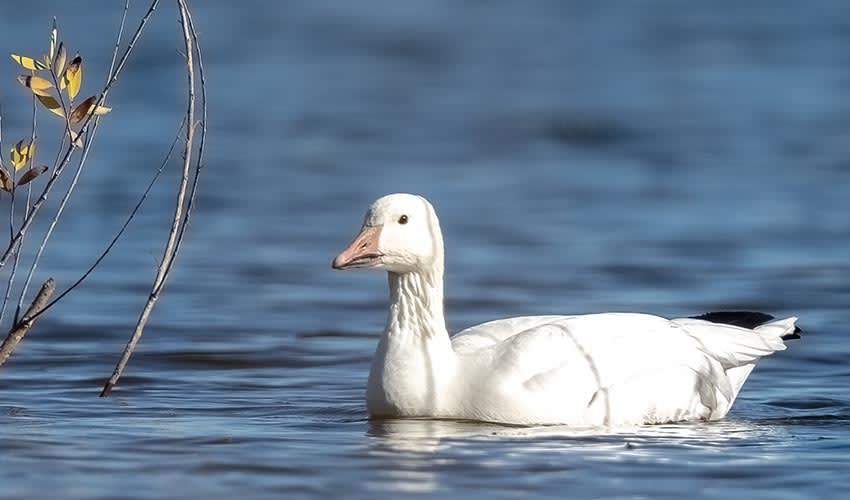
While many waterfowl try to blend into the reeds, the snow goose leans into a look of pure, crystalline white. In its most famous form—the “white morph”—it is a stunning, snowy bird with black-tipped wings that only reveal themselves when it takes flight, making it look like a piece of paper with ink-dipped corners. However, it also has a secret identity known as the “Blue goose.” These birds aren’t actually blue; they are a dark, smoky gray with a bright white head. For a long time, people thought they were two different species, but they are actually just different-colored “outfits” for the exact same bird!
If you get close enough to a snow goose, you’ll notice it looks like it’s constantly sharing a private joke. This is due to the “grin patch”—a dark, serrated opening on the side of its pink bill that looks like a permanent smile. But don’t let the smile fool you; that bill is a heavy-duty gardening tool. Unlike other geese that just clip the tops of grass, snow goose are “grubbers.” They use their powerful, notched bills to reach deep into the mud and pull out the entire root of a plant. This high-energy diet is what fuels their incredible migrations, but it also means a large flock can transform a green field into a muddy landscape in a matter of hours.
The most spectacular thing about the snow goose isn’t the individual bird, but the “blizzard” they create when they travel. These are some of the most social birds on the planet, often gathering in massive colonies of tens of thousands. When a flock takes off at once, the sound is like a roaring freight train, and the sky becomes so thick with white wings that it looks like a literal snowstorm in the middle of spring. They are also incredibly vocal; instead of a deep, honking “quack,” they have a high-pitched, nasal yelp that sounds like a chorus of tiny trumpets, creating a wall of sound that can be heard from miles away.
Distribution
 Bahamas
 Barbados
 Belgium
 Belize
 Bermuda
 Bulgaria
 Canada
 Cayman Islands
 China
China Cuba
Cuba Czechia
 Denmark
 Estonia
 Faroe Islands
 Finland
 France
 Germany
 Greenland
 Honduras
 Iceland
 India
India Ireland
 Italy
Italy Japan
Japan Kazakhstan
 Korea
Korea Latvia
 Lithuania
 Marshall Islands
 Mexico
 Netherlands
 North Korea
 Norway
 Poland
 Portugal
 Puerto Rico
 Romania
 Russia
 Saint Pierre
 Spain
Spain Trinidad & Tobago
 Turks & Caicos
 US Virgin Islands
 United Kingdom
 United States
Anything we've missed?
Help us improve this page by suggesting edits. Glory never dies!
Suggest an editGet to know me
Terrestrial / Aquatic
Altricial / Precocial
Polygamous / Monogamous
Dimorphic (size) / Monomorphic
Active: Diurnal / Nocturnal
Social behavior: Solitary / Pack / Flock
Diet: Carnivore / Herbivore / Omnivore / Piscivorous / Insectivore
Migratory: Yes / No
Domesticated: Yes / No
Dangerous: Yes / No




