


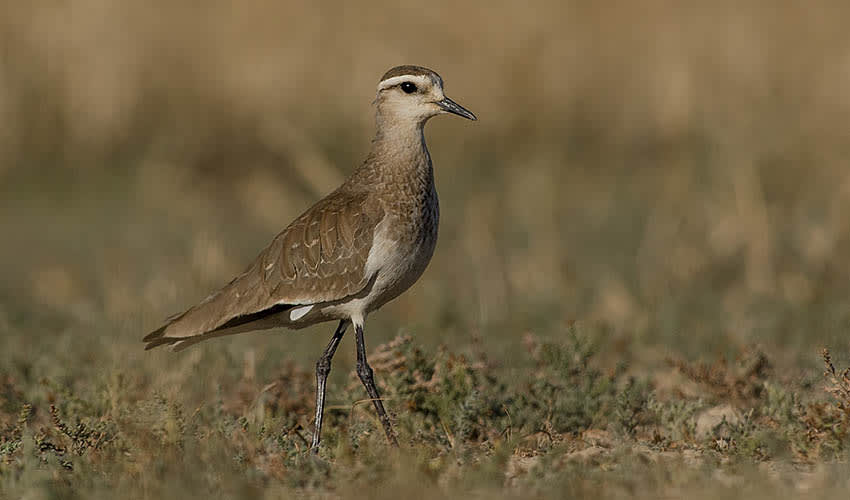
A striking, long-legged shorebird with a graceful build, a clean white face, black cap, sandy-brown back, and elegant black-and-white wing pattern visible in flight. Its name comes from its tendency to gather in large flocks outside the breeding season — a charming trait that once saw thousands moving together across open landscapes. This bird breeds mainly in the grass steppes of Kazakhstan and southern Russia, favoring open plains with sparse vegetation where it can keep watch for predators.
During the breeding season, these lapwings nest on the ground, laying their speckled eggs in shallow scrapes lined with grass. Parents are vigilant, using distraction displays and sharp alarm calls to protect their young from danger. After breeding, they embark on an impressive migration journey, traveling thousands of kilometers to winter in parts of the Middle East, northern Africa, and South Asia, especially around Syria, Iraq, Sudan, and Pakistan. On migration and wintering grounds, they gather in farmland, semi-arid plains, and wetlands, probing for insects, seeds, and small invertebrates. Their presence signals healthy open habitats — but such places are dwindling.
The Sociable lapwing faces grave threats and is currently listed as Critically Endangered. Its main challenge is rapid loss and degradation of steppe habitat, driven by agricultural expansion, changes in livestock grazing, and conversion of grasslands into crop fields. Illegal hunting along migration routes has also been a major problem, particularly in parts of the Middle East. These pressures have caused dramatic population declines, leaving just a few thousand individuals in the wild. Despite the challenges, conservationists have been working tirelessly to protect breeding colonies, monitor migrations using satellite tags, and collaborate with local communities across international routes. These efforts aim not only to protect the species but also to safeguard the ancient flyways it depends on.
Distribution
 Afghanistan
 Armenia
 Austria
 Azerbaijan
 Bahrain
 Belarus
 Belgium
 Bulgaria
 Cameroon
 Central Af. Rep.
 Chad
Chad China
China Official estimate
 Cyprus
 Czechia
 Denmark
 Egypt
Egypt Eritrea
 Ethiopia
 Finland
 France
 Georgia
 Germany
 Greece
 Hungary
 India
India Iran
Iran Iraq
Iraq Ireland
 Israel
 Italy
Italy Jordan
 Kazakhstan
 Kuwait
 Kyrgyzstan
 Lebanon
 Luxembourg
 Maldives
 Malta
Malta Mongolia
 Morocco
 Netherlands
 Nigeria
Official estimate
Nigeria
Official estimate
 Oman
Oman Pakistan
 Poland
 Portugal
 Qatar
Qatar Romania
 Russia
 Saudi Arabia
 Seychelles
 Slovakia
 Slovenia
 Somalia
 Spain
Spain Sri Lanka
 Sudan
Sudan Sweden
 Switzerland
 Syria
Syria Tajikistan
 Turkmenistan
 Turkey
 UAE
UAE Ukraine
Official estimate
Ukraine
Official estimate
 United Kingdom
 Uzbekistan
 Yemen
YemenAnything we've missed?
Help us improve this page by suggesting edits. Glory never dies!
Suggest an editGet to know me
Terrestrial / Aquatic
Altricial / Precocial
Polygamous / Monogamous
Dimorphic (size) / Monomorphic
Active: Diurnal / Nocturnal
Social behavior: Solitary / Pack / Flock
Diet: Carnivore / Herbivore / Omnivore / Piscivorous / Insectivore
Migratory: Yes / No
Domesticated: Yes / No
Dangerous: Yes / No




