


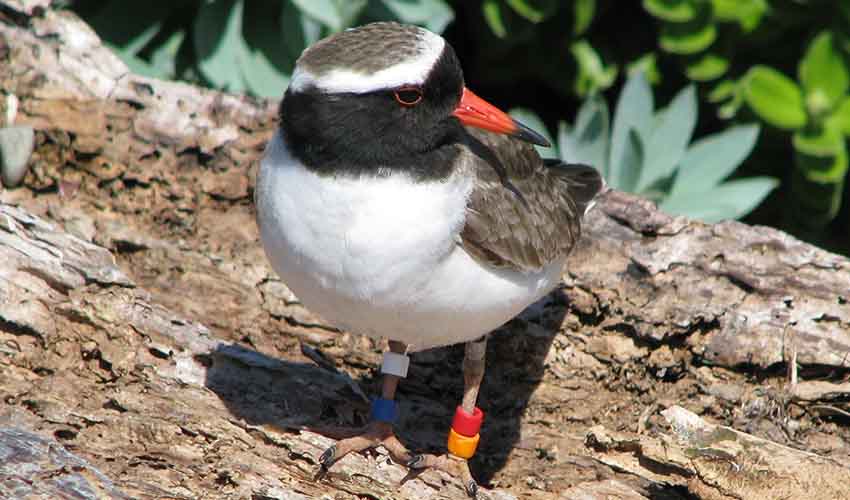
Once found around much of the country’s coastline, it now survives mainly on a handful of small, predator-free islands in the Chatham Islands and near the main islands. At first glance, it’s a small, round, almost toy-like bird: about 20 cm (8 in) long, brown above and white below, with a crisp black (male) or chocolate-brown (female) mask and chest band. Up close, the colours are even more striking—bright orange legs, an orange-red bill with a black tip, and a glowing orange eye-ring that makes the face look very alert and expressive. It’s easy to see why people are so fond of them once they’ve met one.
Shore plovers are true edge-of-the-sea specialists. They favour wave platforms, rocky shorelines, and low, flat coasts where the tide washes over rock and sand, exposing small crabs, worms, and insects. They feed with the classic plover “run–stop–peck” style, scampering a few steps, freezing to stare at the ground, then darting their fine bill down for a quick grab. Their small size and fast legs let them weave in and out of spray and rock pools with ease. When alarmed, they give sharp, piping calls and may run for cover among rocks or low vegetation, but they’re also naturally curious; birds on protected islands sometimes trot right up to people to investigate.
Despite their cheerful look, shore plovers are in serious trouble. For much of the 20th century, the species survived naturally on just one island, Rangatira in the Chathams, and every rat or stoat that reached an island colony caused major losses. To reduce the risk of extinction, conservation teams have spent decades running captive-breeding programmes and moving birds to safe offshore islands such as Mangere, Waikawa/Portland, Mana and Motutapu.
Distribution
 New Zealand
 Official estimate
Anything we've missed?
Help us improve this page by suggesting edits. Glory never dies!
Suggest an editGet to know me
Terrestrial / Aquatic
Altricial / Precocial
Polygamous / Monogamous
Dimorphic (size) / Monomorphic
Active: Diurnal / Nocturnal
Social behavior: Solitary / Pack / Flock
Diet: Carnivore / Herbivore / Omnivore / Piscivorous / Insectivore
Migratory: Yes / No
Domesticated: Yes / No
Dangerous: Yes / No




