


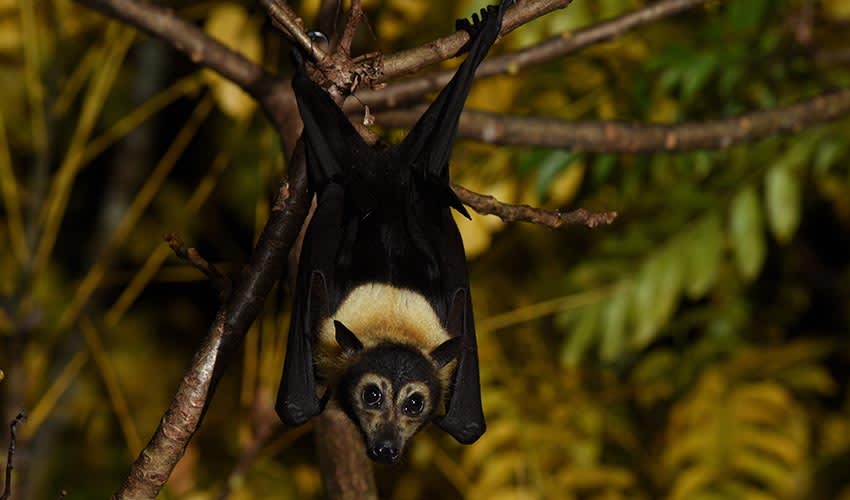
One of Australia’s most eye-catching large fruit bats, named for the pale, mask-like circles of fur around its eyes that look a bit like natural goggles. Found mainly in tropical rainforests of northern Queensland (plus parts of Papua New Guinea and nearby islands), this flying fox is perfectly adapted to a life among tall rainforest trees, where it feeds on nectar, pollen, and fruit. If you’ve ever seen a dark silhouette glide across a tropical dusk sky with quiet, powerful wingbeats — it might’ve been one of these gentle giants.
Despite their size, spectacled flying foxes aren’t hunters — they’re pollinators and seed dispersers, vital to keeping rainforests healthy. As they travel between flowering and fruiting trees, they carry pollen on their fur and drop seeds across vast distances, essentially planting forests as they go. Social by nature, they roost in large communal camps during the day, hanging upside-down from branches like clusters of feathery lanterns. At dusk, thousands can take off at once — a breathtaking sight, and one of the most dramatic wildlife moments in Australia’s tropics.
Mothers typically have one pup a year, carrying it clinging to their belly for several weeks before leaving it in a safe spot at the roost while foraging. Young flying foxes learn to fly and feed gradually, clambering around branches long before they master the air. Communication in the colony can get noisy — expect squeaks, chatters, and squabbles as individuals jostle for space or greet their neighbors. They groom each other too, reinforcing social bonds in what feels like a bat version of a spa day.
Distribution
 Australia
 Official estimate
 Indonesia
 Papua New Guinea
Anything we've missed?
Help us improve this page by suggesting edits. Glory never dies!
Suggest an editGet to know me
Terrestrial / Aquatic
Altricial / Precocial
Polygamous / Monogamous
Dimorphic (size) / Monomorphic
Active: Diurnal / Nocturnal
Social behavior: Solitary / Pack / Colony
Diet: Carnivore / Frugivore / Omnivore / Piscivorous / Insectivore
Migratory: Yes / No
Domesticated: Yes / No
Dangerous: Yes / No




