


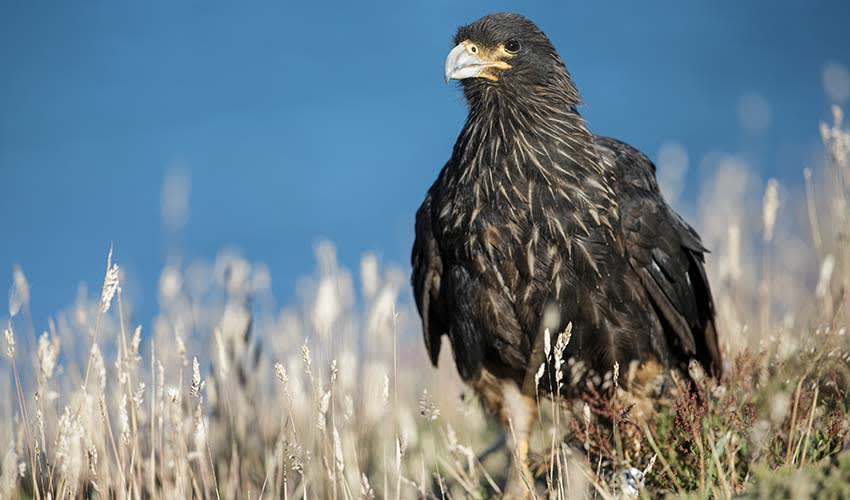
Found mainly on the Falkland Islands and around the far south of Chile and Argentina, it lives on wind-blasted coasts and islands where seabirds and seals crowd the shores. Locals know it as the “Johnny rook,” while early sailors and whalers cursed it as a “flying devil” or “flying monkey” because it was always underfoot, poking around their camps and ships. Unlike many falcons that look sleek and distant as they soar overhead, striated caracaras often strut around on the ground, staring right back at you with a sharp, curious gaze, clearly trying to figure out what you’re doing—and whether they can steal something from you.
What really makes this bird different from most other raptors is its personality and brainpower. Striated caracaras have been shown in recent studies to solve puzzle tasks at a level similar to some famously clever parrots, repeatedly working out how to open complex boxes or reach hidden food. They don’t just wait for food to appear; they actively explore, flip over rocks, investigate ropes, zippers, and pockets, and even play with objects for no obvious reason other than interest.
Compared with other falcons, which are usually focused hunters of fast-moving prey, striated caracaras behave more like feathered problem-solvers, mixing scavenging, hunting, and constant experimentation. They often gather in noisy groups, especially around carcasses or seabird colonies, using calls to recruit one another—almost like a gang showing up when someone yells, “Food’s here!”
Their lifestyle is just as unusual as their temperament. Instead of living in forests or inland plains, striated caracaras cling to the tough edges of the South Atlantic, especially islands with seabird colonies and sheep farms. They eat a bit of everything: dead seabirds and seals, scraps from farms, insects, worms, eggs and chicks of other birds, and even weak or newborn lambs if the chance arises.
Distribution
 Argentina
 Chile
Chile Falkland Islands
Anything we've missed?
Help us improve this page by suggesting edits. Glory never dies!
Suggest an editGet to know me
Terrestrial / Aquatic
Altricial / Precocial
Polygamous / Monogamous
Dimorphic (size) / Monomorphic
Active: Diurnal / Nocturnal
Social behavior: Solitary / Pack / Herd
Diet: Carnivore / Herbivore / Omnivore / Piscivorous / Insectivore
Migratory: Yes / No
Domesticated: Yes / No
Dangerous: Yes / No




