


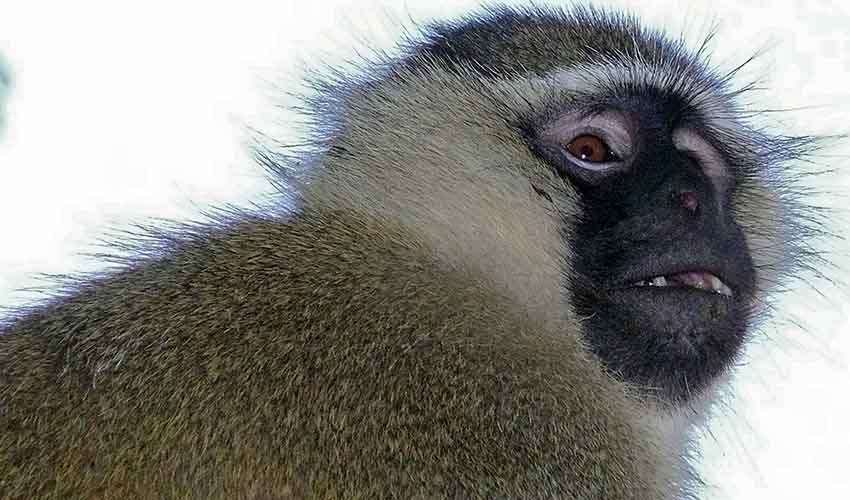
A lively and adaptable Old World monkey found across central Africa, especially in savannas, riverine forests, and wooded grasslands stretching from Senegal and Ghana to Uganda and western Kenya. As a member of the Chlorocebus genus—alongside vervet, green, and Malbrouck monkeys—the Tantalus monkey shares the group’s energetic personality, expressive face, and remarkable ability to thrive in a wide range of environments. Its mix of agility, intelligence, and striking facial markings makes it one of the most recognizable monkeys across the African transition zones between forest and savanna.
The Tantalus monkey is medium-sized with a slender, graceful build. Its fur is generally greenish-gray or olive-toned, helping it blend seamlessly into the dappled light of savanna woodlands. The belly and insides of the limbs are pale or white, while the hands and feet are typically darker, even black. The most distinctive feature of the species is its white band of fur across the brow, giving it a “masked” appearance that highlights its large, curious eyes. The face itself is dark, bordered by lighter fur that makes expressions especially vivid. The long, slender tail—often longer than the body—serves as both a balancing pole and a communication tool.
As omnivores, Tantalus monkeys have a highly flexible diet. They feed on fruits, seeds, leaves, flowers, insects, small vertebrates, and even bird eggs when available. This ability to switch easily between plant and animal foods contributes to their success in many habitats, including landscapes altered by humans. They often forage both in trees and on the ground, moving gracefully between branches or scanning for food in tall grasses. In agricultural areas, they sometimes raid crops such as maize, groundnuts, and fruit, which brings them into conflict with farmers—but also demonstrates their adaptability.
Distribution
 Benin
Benin Burkina Faso
 Cameroon
 Central Af. Rep.
 Chad
Chad DR Congo (Kinshasa)
 Ghana
Ghana Niger
Niger Nigeria
 South Sudan
 Sudan
Sudan Togo
Togo Uganda
Anything we've missed?
Help us improve this page by suggesting edits. Glory never dies!
Suggest an editGet to know me
Terrestrial / Aquatic
Altricial / Precocial
Polygamous / Monogamous
Dimorphic (size) / Monomorphic
Active: Diurnal / Nocturnal
Social behavior: Solitary / Pack / Herd
Diet: Carnivore / Herbivore / Omnivore / Piscivorous / Insectivore
Migratory: Yes / No
Domesticated: Yes / No
Dangerous: Yes / No




