


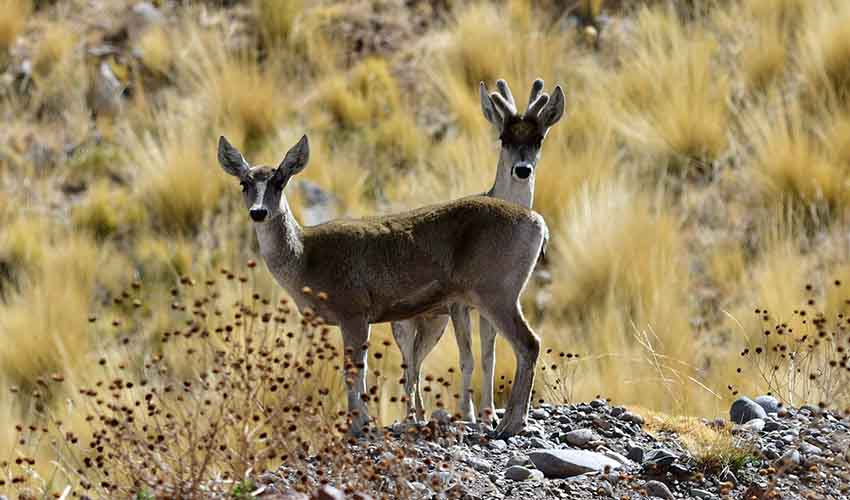
Instead of the long, slim legs and delicate build many people picture when they think of deer, the taruca is stocky and strong, with a thick body, short powerful legs and a dense coat. Its fur is mostly grey-brown, which blends beautifully with rocky ground and dry grass, and it has a paler belly and throat. The males are especially striking: their faces carry bold dark markings that often form a Y- or V-shaped pattern from the nose up the forehead, like a natural mask or war paint. Their antlers are simple but handsome—just two points forming a clean V-shape, rather than a big branching rack.
Tarucas live high in the Andes mountains, in places where nights are freezing, days can be bright and harsh, and the air is thin. Their home is a mix of puna grasslands, rocky slopes and scattered patches of shrubs and low bushes. In these open landscapes they need to be alert at all times, so their colouring and quiet movements are important for avoiding pumas and other predators. Even though they live among grasses, tarucas actually prefer to browse on shrubs and herbs for much of the year, only switching to more grass when the rainy season brings a flush of fresh growth. Their sturdy build and strong hooves let them climb steep slopes, cross loose rock and move easily along narrow ridges where many other animals would struggle.
Socially, tarucas have a relaxed and flexible style. They are not strict loners, but they also don’t form big, tight herds. Instead, they drift in and out of small groups that can range from just a few animals to a couple of dozen, often with females and young forming the core and adult males moving between groups.
Distribution
 Argentina
 Official estimate
 Bolivia
Official estimate
Bolivia
Official estimate
 Chile
Official estimate
Chile
Official estimate
 Peru
Official estimate
Peru
Official estimate
Anything we've missed?
Help us improve this page by suggesting edits. Glory never dies!
Suggest an editGet to know me
Terrestrial / Aquatic
Altricial / Precocial
Polygamous / Monogamous
Dimorphic (size) / Monomorphic
Active: Diurnal / Nocturnal
Social behavior: Solitary / Pack / Herd
Diet: Carnivore / Herbivore / Omnivore / Piscivorous / Insectivore
Migratory: Yes / No
Domesticated: Yes / No
Dangerous: Yes / No




