


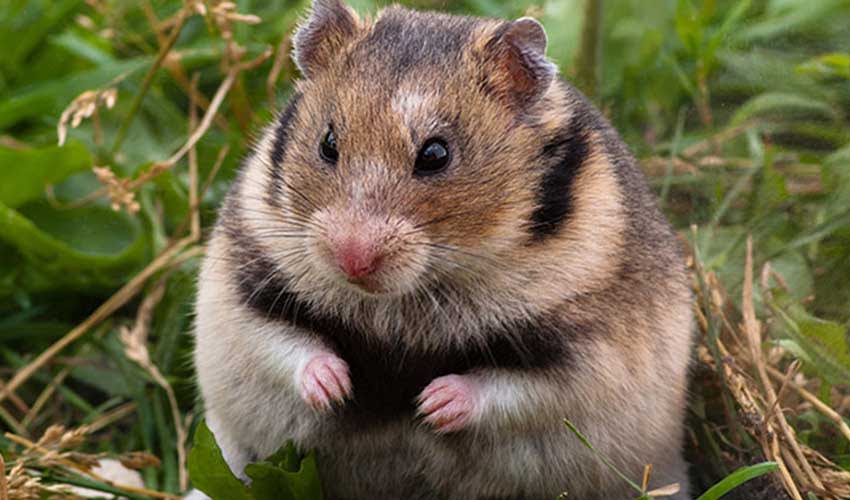
A lesser-known cousin of the popular Syrian hamster, but it lives a much wilder, more rugged life across the dry steppes and farmlands of central Turkey, Armenia, and parts of Iran. Slightly smaller and often darker than its golden-coated relative, this species tends to have brownish-gray fur with paler underparts, a sturdy body, and a short tail almost hidden beneath its fluff. It’s built like a compact survivalist — quiet, strong, and always ready to retreat underground at the first hint of danger.
In the wild, Turkish hamsters carve out complex burrow systems beneath open fields and grasslands. A single burrow can include multiple chambers, a nesting room lined with plant fibers, and storerooms packed with seeds and grains. Their cheek pouches allow them to ferry food back home in impressive quantities — a behavior essential in landscapes where seasons swing sharply between dry heat and chilling winters. Mostly nocturnal, they come out at dusk to forage for seeds, grasses, roots, and the occasional insect, then vanish again before dawn.
These hamsters are strictly solitary. Each animal maintains its own burrow and territory, and interactions outside of breeding season are usually tense or aggressive. That independent streak, common across their genus, explains why pet hamsters aren’t good roommates — in the wild, sharing space isn’t part of their survival plan. Breeding typically happens in warmer months, and females raise the young alone in the safety of the burrow until they’re ready to disperse and dig their own homes.
The Turkish hamster once quietly thrived across wide open spaces, but its numbers have faced pressures from intensive farming, land conversion, and pesticide use. In some regions, it was historically treated as an agricultural pest due to grain-hoarding habits, though today it is much rarer than people realize.
Distribution
 Armenia
 Azerbaijan
 Georgia
 Iran
Iran Russia
 Turkey
Anything we've missed?
Help us improve this page by suggesting edits. Glory never dies!
Suggest an editGet to know me
Terrestrial / Aquatic
Altricial / Precocial
Polygamous / Monogamous
Dimorphic (size) / Monomorphic
Active: Diurnal / Nocturnal
Social behavior: Solitary / Pack / Herd
Diet: Carnivore / Herbivore / Omnivore / Piscivorous / Insectivore
Migratory: Yes / No
Domesticated: Yes / No
Dangerous: Yes / No




