


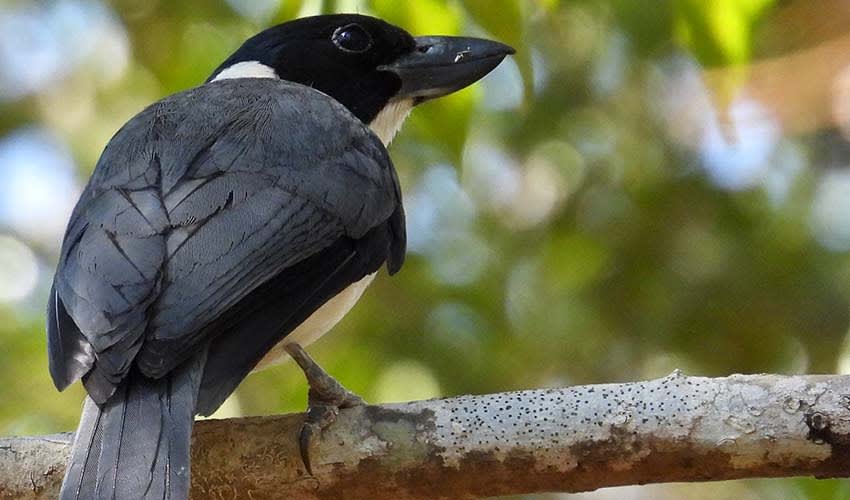
A bird that looks elegant at first glance and then surprises you with its unusual tools and habits. It’s a medium-sized vanga with a strong, pale bluish bill that seems a little oversized for its head, as if it were designed for heavy-duty work rather than delicate snacking. Its plumage is mostly dark and cool-toned, which helps it blend into shaded branches, but it still has a crisp, handsome presence when you finally get a clear view. There’s also a neat difference between the sexes that can help with identification: males tend to show a darker, more extensive black hood, while females often have a smaller black cap.
What really sets Van Dam’s vanga apart is where it lives—and how little of the world it occupies. It is found only in Madagascar, and even there, it is limited to a small part of the island’s northwestern dry forests. This is not a lush rainforest with constant green; it’s a seasonal landscape where trees may lose leaves, sunlight pours through open canopies, and the undergrowth can feel dry and brittle for part of the year. Van Dam’s vanga depends on remaining patches of intact dry deciduous woodland, a habitat that has become increasingly fragmented.
Van Dam’s vanga belongs to a small set of vangas that use their bills in a very practical, hands-on way: instead of only picking insects off leaves, they work on bark and branches to uncover hidden prey. The bill is shaped to pry and strip, letting the bird expose insects tucked under bark or hidden in crevices—like lifting the lid on a snack container that other birds can’t open. You may see it pause on a trunk, brace itself, and then work at the surface with deliberate, efficient movements before snapping up whatever it has revealed.
Distribution
 Madagascar
 Official estimate
Anything we've missed?
Help us improve this page by suggesting edits. Glory never dies!
Suggest an editGet to know me
Terrestrial / Aquatic
Altricial / Precocial
Polygamous / Monogamous
Dimorphic (size) / Monomorphic
Active: Diurnal / Nocturnal
Social behavior: Solitary / Pack / Herd
Diet: Carnivore / Herbivore / Omnivore / Piscivorous / Insectivore
Migratory: Yes / No
Domesticated: Yes / No
Dangerous: Yes / No




