


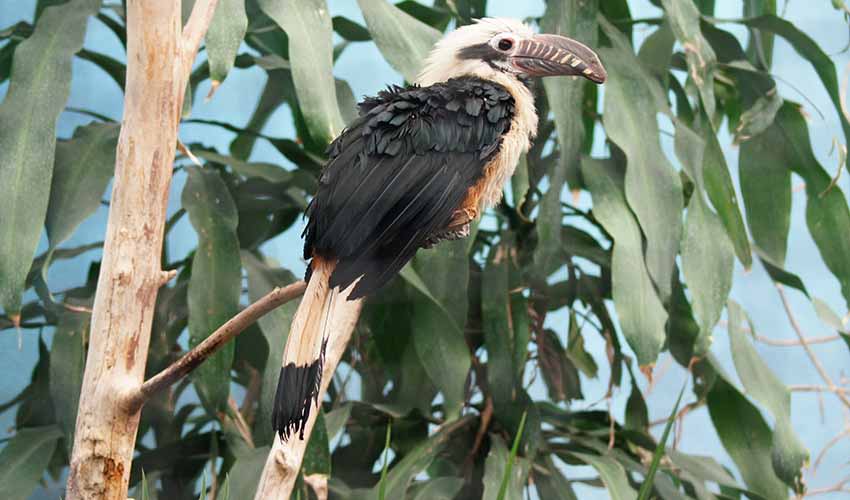
One of the most distinctive birds of the Philippines, known for its bold looks and its important role in island forests. It lives in the Western Visayas, especially on the islands of Panay and Negros, where it depends on remaining patches of native forest. At a glance, it is easy to recognize it as a hornbill: a large bird with a long bill and a noticeable casque, the helmet-like structure on its bill. The Visayan hornbill’s colors are striking, with strong contrasts that make it stand out—dark body feathers paired with lighter markings, and a bill that can look pale and impressive. In flight, it appears strong and direct, with heavy wingbeats that carry it from one fruiting tree to another.
Like most hornbills, this species is closely tied to fruit. It eats figs and many other forest fruits, along with the occasional insect or small animal. Because it travels to feed and then moves on, it spreads seeds across wide areas, helping forests regenerate. This makes the Visayan hornbill more than just a beautiful bird—it is a key helper in keeping forest ecosystems healthy. Many tropical trees rely on large birds to carry their seeds far enough to grow in new places, and hornbills are among the best at this job.
What distinguishes the Visayan hornbill from many other hornbills is its very restricted island range and its strong dependence on lowland forest habitats that have been heavily reduced. While some hornbill species can survive in a wider variety of landscapes, this one is closely linked to intact native forest, especially where tall, old trees are still present. Because it is limited to only a few islands, any loss of habitat has a much bigger effect on the entire species than it would for a bird spread across a whole continent.
Distribution
 Philippines
 Official estimate
Anything we've missed?
Help us improve this page by suggesting edits. Glory never dies!
Suggest an editGet to know me
Terrestrial / Aquatic
Altricial / Precocial
Polygamous / Monogamous
Dimorphic (size) / Monomorphic
Active: Diurnal / Nocturnal
Social behavior: Solitary / Pack / Flock
Diet: Carnivore / Frugivore / Omnivore / Piscivorous / Insectivore
Migratory: Yes / No
Domesticated: Yes / No
Dangerous: Yes / No




