


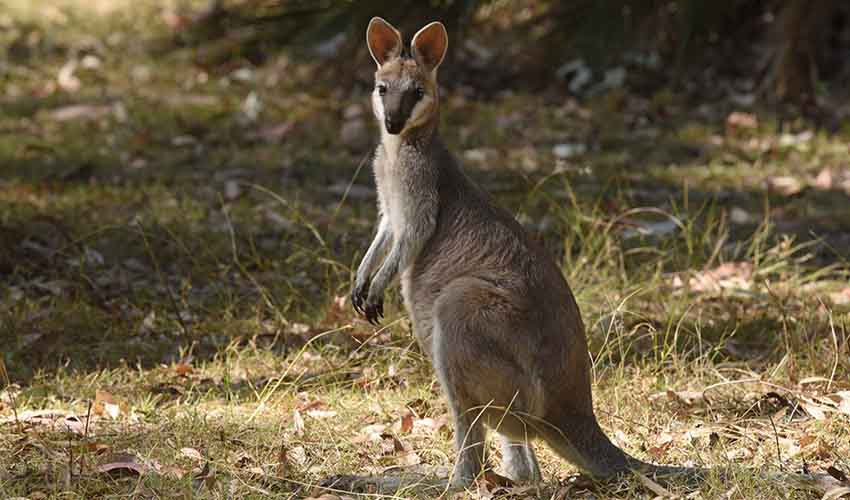
A sleek, fast-moving wallaby with a name that perfectly matches its look. It has a noticeably long, slim tail that can seem “whip-like” compared with the thicker tails of many other wallabies, and that tail helps with balance when it lands and changes direction at speed. Its body is lean and athletic, built for quick travel across open country. The coat is usually a soft gray-brown, often with paler underparts, and it can have subtle face markings that give it a clean, alert expression.
While brush-loving species prefer thick shrubs and forest edges, whiptails are often associated with grasslands, savannas, and open woodland where there’s room to move and a clear view of danger. That open-country life helps explain its build: longer limbs, a lighter frame, and an almost “built-to-cruise” feel compared with more compact, cover-hugging wallabies. It’s also known for being relatively social, sometimes seen feeding in groups, which can add extra safety—more eyes and ears to spot trouble. In places where multiple wallaby species live, the whiptail’s combination of slender shape and preference for more open ground can help distinguish it from stockier wallabies that stay closer to dense cover.
Its daily rhythm is a mix of feeding, scanning, and smart timing. Whiptail wallabies typically graze on grasses and other low plants, often feeding more actively when temperatures are milder—early morning and late afternoon—then resting during the hottest part of the day. Even while feeding, they often pause, lifting their heads to look around, ears swiveling like radar dishes. If a threat appears, their first choice is usually speed and distance: they can bound away in quick, efficient hops, covering ground rapidly and using their tail to stabilize landings and sharp turns. Their movement can look smooth and almost effortless, like a springy glide over the landscape, especially when they’re traveling across relatively even ground.
Distribution
 Australia
Anything we've missed?
Help us improve this page by suggesting edits. Glory never dies!
Suggest an editGet to know me
Terrestrial / Aquatic
Altricial / Precocial
Polygamous / Monogamous
Dimorphic (size) / Monomorphic
Active: Diurnal / Nocturnal
Social behavior: Solitary / Pack / Herd
Diet: Carnivore / Herbivore / Omnivore / Piscivorous / Insectivore
Migratory: Yes / No
Domesticated: Yes / No
Dangerous: Yes / No




