


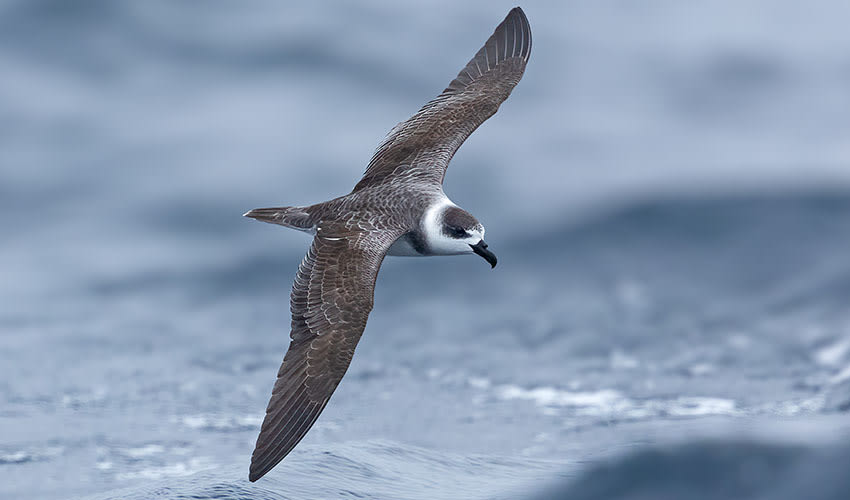
A striking and energetic seabird that spends most of its life roaming the open oceans of the Southern Hemisphere. It gets its name from the pale collar that wraps around its neck, which contrasts sharply with its dark cap, back, and wings. This bold pattern makes it easy to recognize when it sweeps low over the waves. Medium-sized but powerful, the white-necked petrel is built for speed and endurance. Its long, narrow wings allow it to glide smoothly and then suddenly burst into rapid flight, a style perfectly suited for searching wide stretches of ocean.
Unlike smaller, more delicate-looking petrels, this species is robust and assertive. It breeds mainly on remote islands, often choosing steep, forested slopes where it digs burrows for nesting. These nesting sites provide protection from weather and predators but require strength and determination to access. White-necked petrels are also known for their loyalty to breeding areas, returning to the same islands year after year. During the breeding season, pairs form strong bonds and work together to raise a single chick, sharing duties such as guarding the nest and searching for food.
At sea, the white-necked petrel is an active and skilled forager. It feeds mainly on squid, fish, and other small sea creatures, often catching prey near the ocean’s surface. It uses a combination of sharp eyesight and a strong sense of smell to locate food across vast, seemingly empty waters. The bird’s flight style is fast and purposeful, with quick changes in direction as it follows wind patterns and ocean currents. It is not unusual for a white-necked petrel to travel enormous distances in search of food, sometimes crossing entire ocean regions during a single foraging journey.
Distribution
 American Samoa
 Australia
 Cook Islands
 Fiji
Fiji French Polynesia
 French Southern T.
 Guam
Guam Japan
Japan Kiribati
 Marshall Islands
 Mexico
 Micronesia
 Nauru
Nauru New Caledonia
 New Zealand
 Niue
Niue Norfolk Island
 Nort. Mariana Is.
 Papua New Guinea
 Samoa
Samoa Solomon Islands
 Tokelau
 Tonga
Tonga Tuvalu
 US Minor Is.
 United States
 Vanuatu
 Wallis & Futuna
Anything we've missed?
Help us improve this page by suggesting edits. Glory never dies!
Suggest an editGet to know me
Terrestrial / Aquatic
Altricial / Precocial
Polygamous / Monogamous
Dimorphic (size) / Monomorphic
Active: Diurnal / Nocturnal
Social behavior: Solitary / Pack / Flock
Diet: Carnivore / Herbivore / Omnivore / Piscivorous / Insectivore
Migratory: Yes / No
Domesticated: Yes / No
Dangerous: Yes / No




