


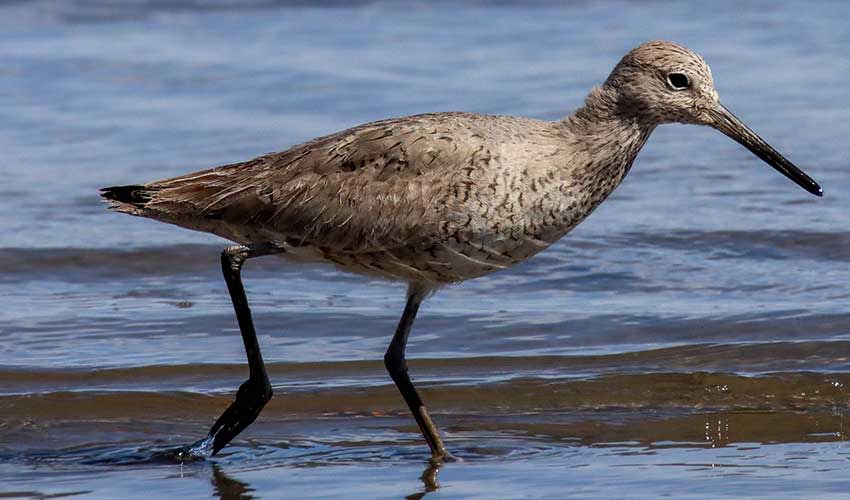
At first glance, it looks like a fairly plain, oversized sandpiper—a sturdy, grey-brown bird with a heavy bill and long, bluish-grey legs that blends perfectly into the salt marshes and rocky coasts. However, the moment it takes flight, it undergoes a spectacular transformation. Its wings reveal a bold, high-contrast black-and-white “zebra” pattern that flashes like a strobe light against the sky. This “wing-flash” is its signature move, distinguishing it instantly from any other large shorebird and acting as a clear signal to its flock mates that it’s time to move.
What truly makes a willet a willet, though, is its voice. These are not quiet, shy birds; they are the self-appointed “alarm systems” of the coast. They are named after their loud, ringing three-note call: “pill-will-willet!” They are incredibly vocal and will scream at anything they find suspicious—be it a passing hawk, a curious dog, or a person walking too close to their nesting site. Because they are so loud and defensive, other, more timid shorebirds often hang around Willets, using them as a free security service. If the Willet starts shouting, every other bird in the marsh knows it’s time to head for cover.
A fun bit of trivia about the Willet is their “sensitive” eating habits. Their thick, straight bill is packed with sensitive nerve endings at the very tip, allowing them to hunt by touch as much as by sight. This is a huge advantage because it means they can keep hunting long after the sun goes down or in murky, stirred-up water where other birds would go hungry. They are also known for their “crab-cracking” skills; they will catch a small crab, shake it vigorously to break off its legs, and then swallow the body whole. They are rugged, loud, and full of surprises—the bold guardians of the shoreline.
Distribution
 Anguilla
 Antigua & Barbuda
 Argentina
 Aruba
Aruba Bahamas
 Barbados
 Belize
 Bermuda
 Bonaire Sint Eustatius And Saba
 Brazil
 British Virgin Is.
 Canada
 Cayman Islands
 Chile
Chile Colombia
 Costa Rica
 Cuba
Cuba Curaçao
 Dominica
 Dominican Republic
 Ecuador
 El Salvador
 Finland
 France
 French Guiana
 Grenada
Guadeloupe
Grenada
Guadeloupe Guatemala
 Guyana
 Haiti
Haiti Honduras
 Jamaica
Martinique
Jamaica
Martinique Mexico
 Montserrat
 Nicaragua
 Norway
 Panama
 Peru
Peru Portugal
 Puerto Rico
 Saint Barthélemy
 Saint Lucia
 Saint Martin
 Saint Pierre
 Saint Vincent
 Sint Maarten
 St. Kitts & Nevis
 Suriname
 Trinidad & Tobago
 Turks & Caicos
 US Minor Is.
 US Virgin Islands
 United States
 Uruguay
 Venezuela
Anything we've missed?
Help us improve this page by suggesting edits. Glory never dies!
Suggest an editGet to know me
Terrestrial / Aquatic
Altricial / Precocial
Polygamous / Monogamous
Dimorphic (size) / Monomorphic
Active: Diurnal / Nocturnal
Social behavior: Solitary / Pack / Flock
Diet: Carnivore / Herbivore / Omnivore / Piscivorous / Insectivore
Migratory: Yes / No
Domesticated: Yes / No
Dangerous: Yes / No




