Automolus
Famous for tearing into curled, brown leaf clusters and vine tangles to find insects hiding inside
A group of brown, forest-dwelling birds in the ovenbird family that specialize in working the messy layers of leaves, vines, and dead plant matter in tropical forests. Most Automolus look understated—warm browns, cinnamon, or olive-browns with a slightly “dusty” forest tone that helps them blend into shade—but they have a distinctive, purposeful shape: a fairly sturdy body, a strong bill, and a tail that often looks worn or pointed from constant contact with vegetation. They’re birds of the mid-to-lower forest, not the open canopy, and they spend their days methodically searching for hidden snacks in places most animals ignore, like curled dead leaves caught in tangles, or clumps of decaying plant material hanging above the ground.
Many small tropical birds pick insects off leaf surfaces, but Automolus often targets leaf clusters, suspended dead leaves, vine tangles, and messy pockets of debris where spiders, roaches, caterpillars, and beetle larvae hide. They don’t just “pluck”—they tug, flip, and probe, sometimes pulling apart leaf bundles with quick, practiced movements. This gives them a niche that reduces competition with birds that forage more neatly on green leaves or bark. They’re also more often detected by their voices than by their looks. Automolus species frequently have strong, recognizable songs—whistles, rising series, or ringing phrases—that carry through dense forest, acting like an audio flag that says, “This patch is taken.”
Automolus species are found across tropical Central and South America, with many living in humid lowland rainforests, foothill forests, and sometimes at the edges of cloud forests. They often move alone or in pairs, but will also join mixed-species foraging groups—those roaming “bird squads” where different species travel together, each searching in its own way. In a group, Automolus can play the role of the “leaf-cluster specialist,” cleaning out hiding spots that others overlook. Their nests (like many relatives in the same family) tend to be well-hidden and can be placed in protected spots such as banks, cavities, or concealed structures, which fits their secretive style.

Species in this genus
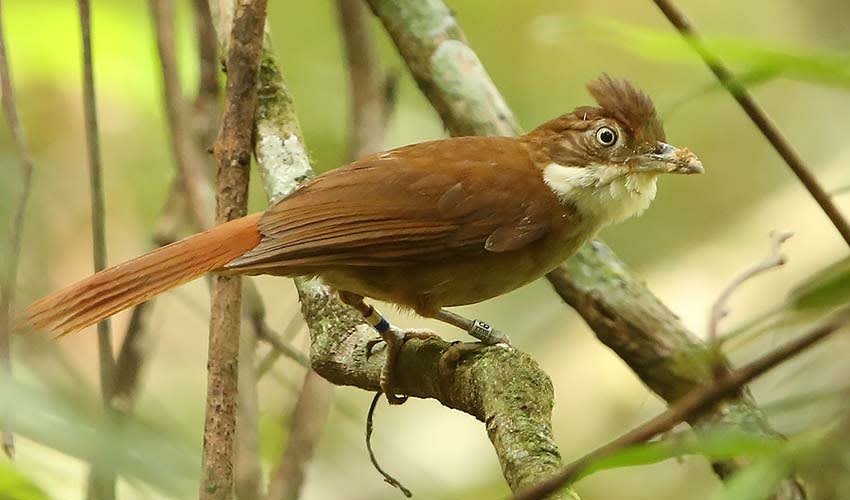


Pernambuco foliage-gleaner
Loves rummaging through clumps of dried leaves caught in vines

