


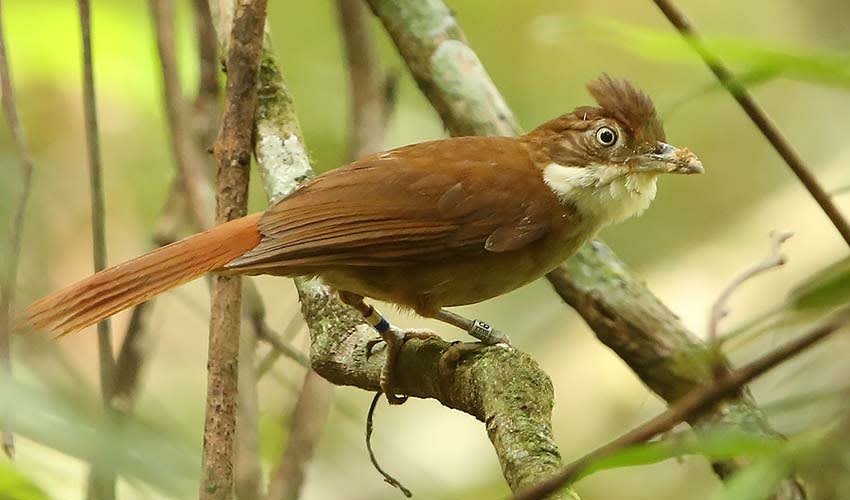
At first glance, it doesn’t look flashy—its feathers are mostly warm brown with touches of rufous and olive—but in the dim, tangled world of tropical forest understory, those quiet colors are exactly what it needs. Like other foliage-gleaners, it is built for a life of careful searching rather than speed or showiness. It has a strong, slightly curved bill, sturdy legs, and a purposeful, almost serious expression, as if it is always concentrating on its next task.
True to its name, the Pernambuco foliage-gleaner makes its living by “gleaning,” or picking small insects and spiders from leaves and debris. But it doesn’t just pick food from open surfaces. This bird is a specialist at investigating messy corners of the forest: clumps of dead leaves caught in vines, tangles of twigs, and folds of hanging vegetation. It will tug at leaf bundles, flip them over, and probe into every crease, searching for hidden prey. Watching one at work is like watching a tiny detective methodically checking every possible hiding place.
One of the most interesting things about this bird is how little of the world it occupies. It lives only in a few remaining patches of Atlantic Forest in the Brazilian state of Pernambuco and nearby areas. That makes it a true regional specialty—if you leave that small zone, you won’t find it anywhere else on Earth. Within those forests, it tends to stay in the lower and middle levels of vegetation, moving quietly through the shadows. It is not a bird of open spaces or city parks; it depends on mature, intact forest with plenty of vines, leaf litter, and natural clutter.
Distribution
 Brazil
 Official estimate
Anything we've missed?
Help us improve this page by suggesting edits. Glory never dies!
Suggest an editGet to know me
Terrestrial / Aquatic
Altricial / Precocial
Polygamous / Monogamous
Dimorphic (size) / Monomorphic
Active: Diurnal / Nocturnal
Social behavior: Solitary / Pack / Flock
Diet: Carnivore / Herbivore / Omnivore / Piscivorous / Insectivore
Migratory: Yes / No
Domesticated: Yes / No
Dangerous: Yes / No




