Bdeogale
Remarkably quiet hunters, moving with almost no sound through leaves and undergrowth
Found across sub-Saharan Africa, these animals are less famous than their open-country cousins like meerkats or banded mongooses, but they represent a fascinating, lesser-known branch of the mongoose family. Members of Bdeogale are highly adapted to life in dense vegetation—whether tropical forests, mountain woodlands, or moist savannas—and are known for their intelligence, curiosity, and stealthy nature.
Physically, these mongooses are medium-sized carnivores. Their coats are coarse and dark, varying from grayish-brown to reddish or blackish, with lighter underparts in some populations. The fur is thick and shaggy, well-suited for life in humid or forested environments, while the bushy tail—unusual among mongooses—helps with balance and communication. Their legs are short but strong, allowing them to move swiftly through dense undergrowth, and they have sharp claws ideal for digging and foraging. Their faces are short with small, rounded ears and alert eyes, giving them a keen and inquisitive expression typical of mongooses.
Behaviorally, they are elusive, mostly nocturnal, and solitary or live in small family groups. They are adept hunters and foragers, relying heavily on their sense of smell to locate prey. Their diet is omnivorous, consisting primarily of insects, small mammals, birds, amphibians, reptiles, eggs, and fruit. In forested habitats, they are often seen rummaging through leaf litter or turning over logs in search of insects and grubs. The Black-footed mongoose, for example, has a particular fondness for beetles and earthworms, while the Bushy-tailed mongoose often hunts small vertebrates along forest edges and riversides. When feeding, they use their forepaws skillfully to dig, pry, or flip objects—demonstrating impressive dexterity for small carnivores.
These mongooses are known for being highly secretive, rarely seen even in areas where they are common. They move silently through the forest floor, often following established pathways or animal trails. When disturbed, they may emit soft growls or hissing sounds, though they generally prefer retreat over confrontation.

Species in this genus
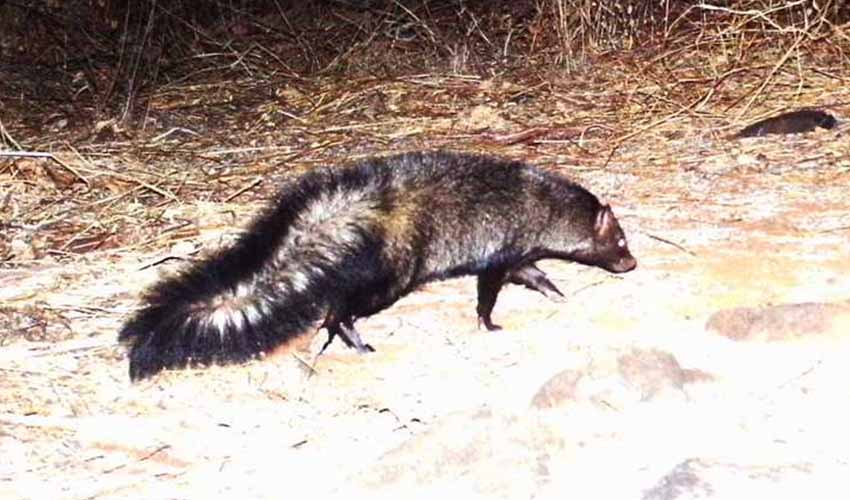


Bushy-tailed mongoose
Ghost of the undergrowth—often detected only by camera traps or its faint tracks in the soil

