


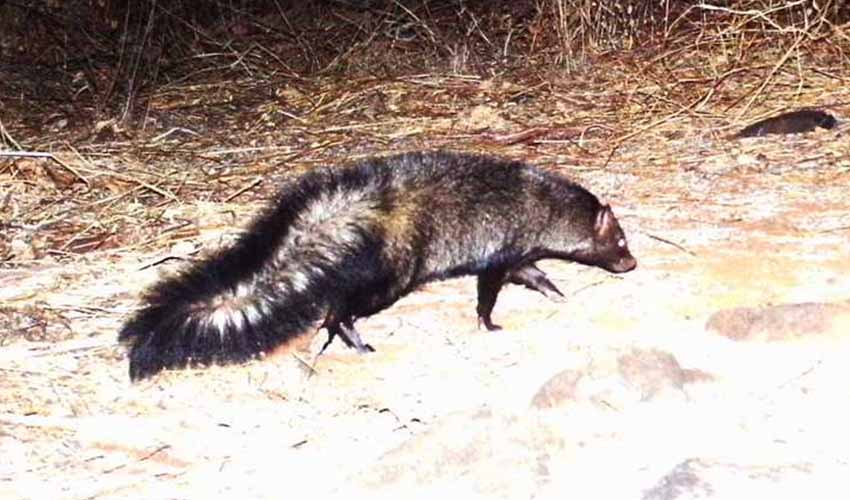
One of Africa’s most elusive and intriguing small carnivores—a shy, nocturnal hunter that roams the forests, woodlands, and savannas of eastern and southeastern Africa. Known for its thick, fluffy tail and quiet, catlike movements, this mongoose stands apart from its more social and open-country cousins like the banded or dwarf mongooses. Instead, it lives a secretive life under the cover of darkness, prowling leaf litter and forest edges in search of insects, small animals, and fruits.
Physically, the bushy-tailed mongoose is a medium-sized, compact carnivore with a distinctive appearance. Its body is stocky and muscular, covered in coarse, dark brown to grayish-black fur, often tinged with reddish hues depending on the region. Its short legs are strong, built for digging and moving through dense underbrush, and its feet and lower legs are often darker, sometimes nearly black. The face is short and rounded, with small ears and bright, alert eyes that shine in torchlight during nighttime observations.
The bushy-tailed mongoose is primarily nocturnal and crepuscular, meaning it is most active at night and during dawn or dusk. During the day, it rests in burrows, hollow logs, termite mounds, or dense vegetation, emerging after sunset to forage. It has a solitary lifestyle, though pairs or small family groups have occasionally been observed, suggesting some flexibility in social behavior. Its movements are deliberate and quiet—this mongoose moves with a low, stealthy gait, tail slightly raised, often sniffing the ground or turning over leaves as it searches for food.
Behaviorally, the bushy-tailed mongoose is a quiet and secretive animal, rarely vocalizing except for low growls or hisses when threatened. It marks its territory with scent secretions from anal glands—common among mongooses—which emit a musky odor used for communication and boundary marking. It is an excellent climber and swimmer, though it prefers staying on the ground.
Distribution
 DR Congo (Kinshasa)
 Kenya
Kenya Malawi
 Mozambique
 Tanzania
 Yemen
Yemen Zambia
 Zimbabwe
Anything we've missed?
Help us improve this page by suggesting edits. Glory never dies!
Suggest an editGet to know me
Terrestrial / Aquatic
Altricial / Precocial
Polygamous / Monogamous
Dimorphic (size) / Monomorphic
Active: Diurnal / Nocturnal
Social behavior: Solitary / Pack / Herd
Diet: Carnivore / Herbivore / Omnivore / Piscivorous / Insectivore
Migratory: Yes / No
Domesticated: Yes / No
Dangerous: Yes / No




