


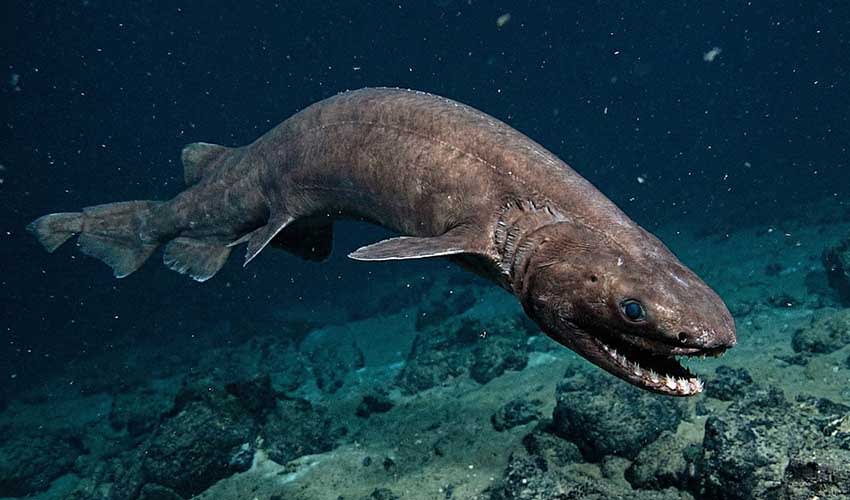
One of the strangest and most fascinating sharks in the ocean, often described as a “living fossil” because it has changed very little over millions of years. Its most striking feature is its long, eel-like body, which makes it look more like a sea serpent than a typical shark. Unlike the sleek, torpedo-shaped bodies of most sharks, the frilled shark is slender and flexible, allowing it to move through deep water with slow, snake-like motions. Its head is broad and flat, with a blunt snout and dark, lidless eyes that give it a mysterious appearance. What truly gives the frilled shark its name are the six pairs of frilly gill slits that run along its neck, forming a ruffled collar that no other living shark has in quite the same way.
Another feature that sets the frilled shark apart from other sharks is its mouth, which is filled with rows of sharp, needle-like teeth. These teeth are curved inward, making it very difficult for prey to escape once caught. While many sharks rely on speed and power to hunt, the frilled shark uses stealth and surprise. It often waits quietly in the deep sea, then suddenly lunges forward to snatch its prey. Its jaws can open very wide, allowing it to swallow animals that are almost half its length. This feeding style is quite different from that of faster, more active sharks like great whites or makos, which chase and bite their prey in open water.
The frilled shark also stands out because of where it lives. Most sharks are found closer to the surface or along coastlines, but frilled sharks prefer the deep sea, usually at depths of several hundred to over a thousand meters. This dark, cold environment has shaped many of their unique traits. Their slow movements help them save energy, which is important in a place where food can be scarce.
Distribution
 Atlantic Ocean
 Indian ocean
 Pacific ocean
 Australia
 Brazil
 Chile
Chile China
China Faroe Islands
 France
 French Guiana
 Guyana
 Ireland
 Japan
Japan Mauritania
 Mexico
 Morocco
 New Zealand
 Norway
 Peru
Peru Portugal
 Senegal
 Spain
Spain Suriname
 Taiwan
 United Kingdom
 United States
Anything we've missed?
Help us improve this page by suggesting edits. Glory never dies!
Suggest an editGet to know me
Terrestrial / Aquatic
Altricial / Precocial
Polygamous / Monogamous
Dimorphic (size) / Monomorphic
Active: Diurnal / Nocturnal
Social behavior: Solitary / Pack / Herd
Diet: Carnivore / Herbivore / Omnivore / Piscivorous / Insectivore
Migratory: Yes / No
Domesticated: Yes / No
Dangerous: Yes / No




