Elephantulus – Long-eared elephant shrews
Despite the name, they’re more closely related to elephants and aardvarks than to mice or true shrews
Tiny African mammals that look like a mash-up of a mouse, a mini-antelope, and, very loosely, an elephant. The “elephant” part comes from their long, flexible snout, which they can wiggle in all directions like a miniature trunk. The “shrew” part is a bit misleading—they aren’t true shrews at all, but belong to their own family, the sengis. Their fur is usually some shade of brown or grey to match dry soil and rocks, and they have big dark eyes and noticeably long ears that give them a very alert, slightly “cartoon” look.
These little sengis are built for speed and for life close to the ground. Long hind legs let them move in quick, springy bounds, which is why elephant shrews are sometimes called “jumping shrews.” On open, sandy, or grassy ground, they can explode into a zigzag sprint, dodging predators like lizards, snakes, and small carnivores.
Many Elephantulus species live in dry savanna, scrub, or rocky slopes, often using old rodent burrows, rock crevices, or gaps under bushes as shelter. By day, they tend to stay hidden; in the cooler hours, they dash out along well-worn runways—little paths they keep clear through grass and leaf litter. Along these routes, they snuffle with that long nose for ants, termites, beetles, spiders, and other tiny invertebrates, snapping them up with quick, precise bites.
One famous member of this group is the East African long-eared elephant shrew, once called Elephantulus rufescens (now often placed in its own genus but still a classic “long-eared” type). It lives in dry savannas and bush in East Africa and is instantly recognizable by its big, almost hairless ears and fine reddish-brown coat. Instead of relying on burrows, it builds a network of narrow trails under fallen leaves and grass, with little “rest stations” along the way where it can sunbathe and scent-mark.

Species in this genus
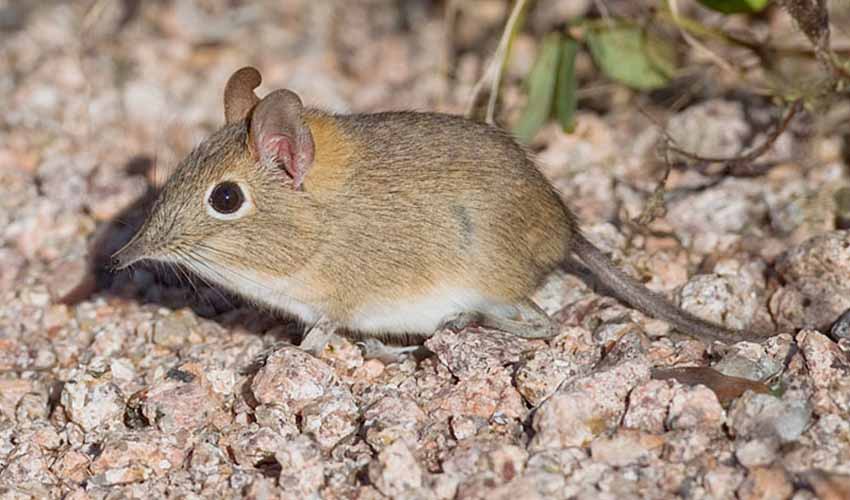


Bushveld elephant shrew
Their snout is super flexible and constantly moving, like a mini trunk used to probe and sniff out prey
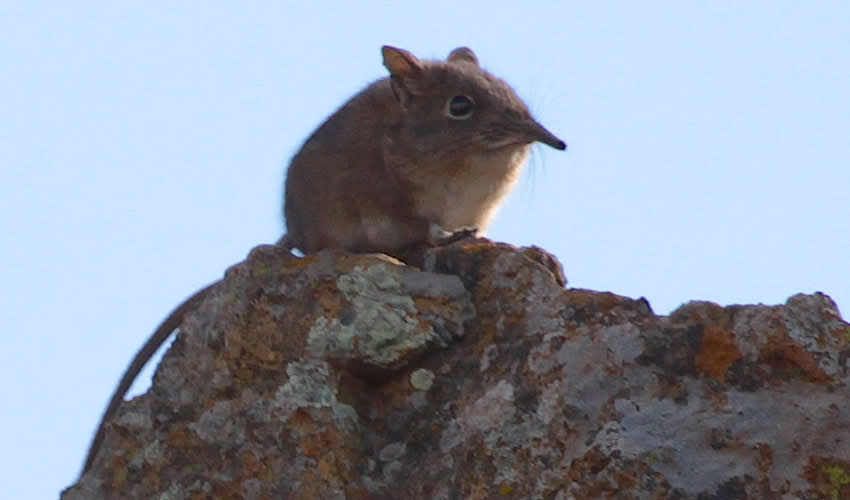
Eastern rock elephant shrew
That long snout works like a little vacuum wand, snuffling along cracks and sand for ants and termites

