


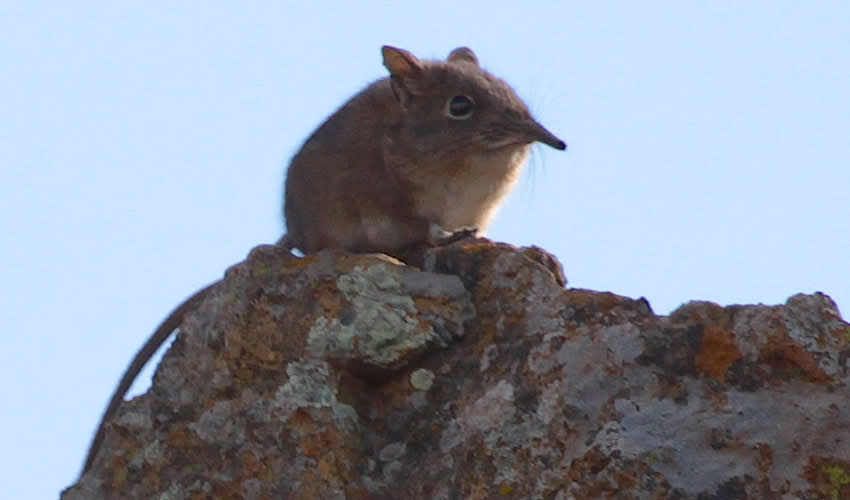
It lives in southern Africa—mainly Botswana, Zimbabwe, Mozambique, and South Africa—where it hugs rocky hillsides, boulder fields, and dry grassland dotted with stones. At first glance, it looks like a mouse, but its long, flexible snout and huge dark eyes give it a very different vibe. The fur is soft grey-brown above and paler underneath, with a neat white eye-ring that makes the eyes pop, so it always looks a bit wide-eyed and surprised.
This little sengi is a rock specialist. Instead of digging its own burrows, it lives among boulders and rock piles, using cracks, ledges, and tiny caves as hiding spots and “front doors.” During the day, it stays tucked in the shade, safe from heat and predators, then in the cooler hours it zips out along familiar paths to hunt. Eastern rock elephant shrews are insect-eaters at heart, focusing on ants, termites, and other small invertebrates that they pick off the ground or from between stones with that long snout and quick tongue. Their legs are surprisingly long for such a tiny body, and when they run they can move in quick, springy bursts, dodging in and out of cover like a wind-up toy on turbo mode.
Eastern rock elephant shrews are usually monogamous, living as pairs that share a territory laced with tiny runways through the rocks. They mark their space with scent from special glands and with droppings at regular spots, so other sengis can “read” the boundaries without a fight. Communication is mostly silent and scent-based; the animals themselves tend to be quiet, relying on their sharp hearing and constant alertness rather than loud calls. When danger appears—a snake, a lizard, or a hunting bird—they freeze for a moment, then bolt along their known escape routes and vanish into the nearest crack as if the rock swallowed them.
Distribution
 Botswana
 Mozambique
 South Africa
 Zimbabwe
Anything we've missed?
Help us improve this page by suggesting edits. Glory never dies!
Suggest an editGet to know me
Terrestrial / Aquatic
Altricial / Precocial
Polygamous / Monogamous
Dimorphic (size) / Monomorphic
Active: Diurnal / Nocturnal
Social behavior: Solitary / Pack / Herd
Diet: Carnivore / Herbivore / Omnivore / Piscivorous / Insectivore
Migratory: Yes / No
Domesticated: Yes / No
Dangerous: Yes / No




