Hemitheconyx – Fat-tailed geckos
The tail is their financial “bank account” in lean times
The fat-tailed geckos are a captivating group of reptiles known for their distinctive, plump tails that serve as both an energy reserve and a survival tool. Found in parts of Africa, Australia, and the Middle East, these geckos have evolved to thrive in arid and semi-arid environments where food and water can be scarce. Their unique adaptations, gentle temperament, and charming appearance make them not only fascinating in the wild but also beloved among reptile enthusiasts.
The fat tail is more than just a cute feature—it’s an ingenious evolutionary adaptation. These geckos store excess fat in their tails, which can later be metabolized for energy and water during times of scarcity. In the wild, where prey may be unpredictable, this allows them to survive for weeks without food. The tail also serves as a defensive mechanism: when threatened by predators, a gecko can detach its tail through a process called autotomy, leaving it twitching behind to distract the attacker while the gecko escapes. Over time, the tail regenerates, though the new one is typically shorter, smoother, and less colorful. The tail’s thickness is also an indicator of health—a plump tail means a well-fed, thriving gecko, while a thin one suggests stress, illness, or malnourishment.
Fat-tailed geckos are nocturnal and prefer to spend the day hiding under rocks, logs, or inside burrows. At night, they emerge to hunt small insects such as crickets, beetles, termites, and roaches. Unlike some geckos that have sticky toe pads for climbing, fat-tailed geckos have clawed feet and smooth toes, making them more adept at walking and digging than scaling walls. Their large, dark eyes give them excellent night vision, and their movements are slow and deliberate, perfect for stalking prey in the dark. They are generally quiet and docile, communicating through subtle body language and, occasionally, soft squeaks when startled.

Species in this genus
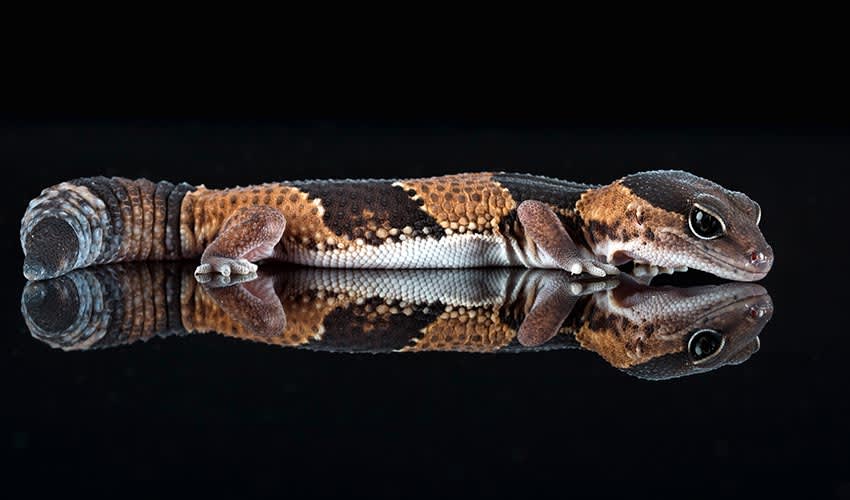


African fat-tailed gecko
Their fat tails act as emergency food storage, helping them survive long periods without eating

