


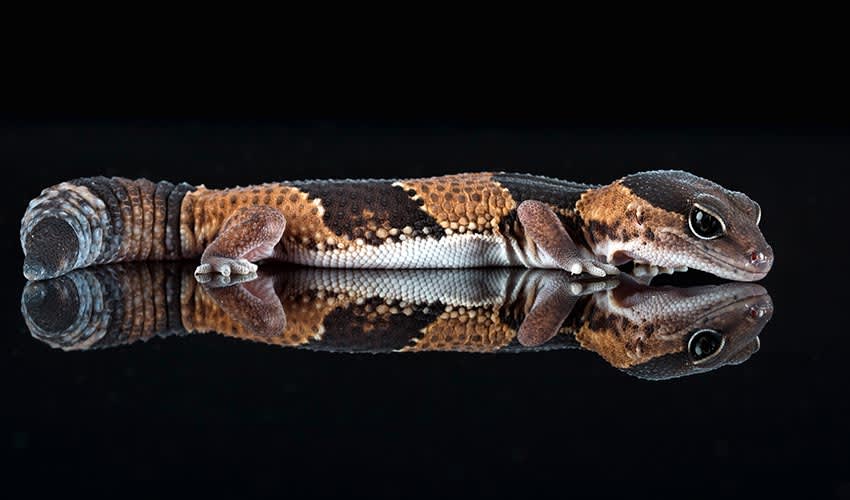
A charming, small-to-medium-sized lizard native to West Africa, known for its gentle temperament and its distinctive, plump tail. Often described as one of the most personable reptiles, it has become a favorite among both herpetologists and reptile enthusiasts. But beyond its popularity in captivity, the African fat-tailed gecko is a fascinating example of adaptation to dry, challenging environments—perfectly evolved to survive the extremes of the African savannas.
These geckos are found in Senegal, Mali, Togo, Ghana, and Nigeria, where they inhabit savannas, semi-arid regions, and dry forests. During the heat of the day, they seek refuge in burrows, under rocks, or in termite mounds, emerging only at night to hunt and explore. Their world is one of extremes—hot, dry days followed by cooler nights—and the African fat-tailed gecko’s physiology reflects that balance between heat tolerance and water conservation. Its most iconic feature, of course, is its fat tail, which serves as both an energy reserve and a water source. When food is plentiful, the tail becomes thick and full; during droughts or lean seasons, it gradually slims down as the stored fat is metabolized for survival.
In appearance, the African fat-tailed gecko is both beautiful and practical in design. The coloration ranges from tan to dark brown, often with two broad stripes running from head to tail, separated by a paler band down the back. Many individuals have a distinct white stripe along the spine, though pattern variations are common. Their large, dark eyes give them excellent night vision, ideal for their nocturnal lifestyle, and their eyelids—unusual among geckos—can blink and close, keeping out dust and debris from their sandy environment. Unlike the sticky-toed geckos that climb walls and trees, fat-tailed geckos have clawed feet designed for digging and walking on the ground.
Distribution
 Benin
Benin Burkina Faso
 Cameroon
 Côte D’ivoire
 Gambia
 Ghana
Ghana Guinea-Bissau
 Guinea
 Mali
Mali Mauritania
 Niger
Niger Nigeria
 Senegal
 Togo
TogoAnything we've missed?
Help us improve this page by suggesting edits. Glory never dies!
Suggest an editGet to know me
Terrestrial / Aquatic
Altricial / Precocial
Polygamous / Monogamous
Dimorphic (size) / Monomorphic
Active: Diurnal / Nocturnal
Social behavior: Solitary / Pack / Herd
Diet: Carnivore / Herbivore / Omnivore / Piscivorous / Insectivore
Migratory: Yes / No
Domesticated: Yes / No
Dangerous: Yes / No




