


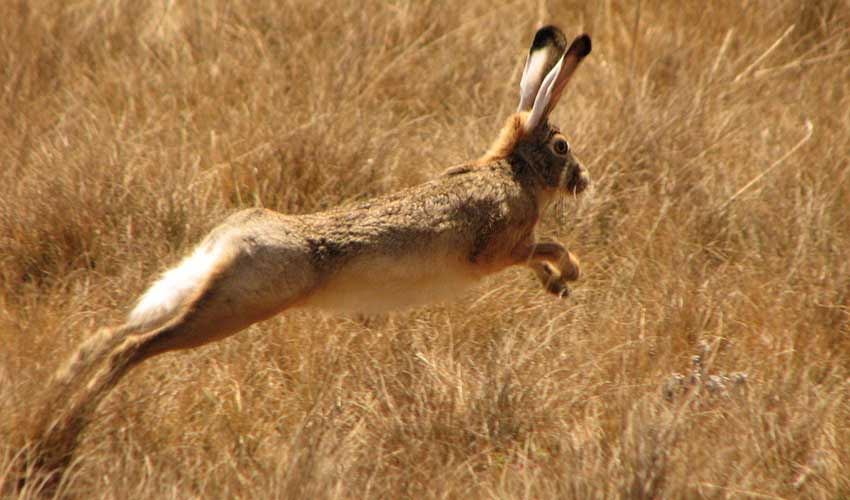
A long-legged, quick-thinking hare built for the open spaces and mixed landscapes of the Horn of Africa. It has the classic “hare” shape: a slim body, powerful hind legs for sudden leaps, and large ears that can swivel to track faint sounds. Its fur is usually a blend of sandy brown, gray, and buff tones—colors that match dry grass, dusty soil, and scattered shrubs. Up close, the coat often looks finely speckled, which helps break up its outline when it sits still. The belly is paler, and the tail is short, so the animal’s most noticeable features are the tall ears and the spring-loaded back legs. When it’s relaxed, it can look almost statue-like, but when startled, it can launch forward in fast, bounding bursts that make it seem to glide over uneven ground.
Compared with hares that live in snowy regions and change dramatically to white in winter, the Abyssinian hare keeps an earthy palette that blends with year-round browns and tans. Compared with woodland hares that depend heavily on thick cover, it often lives in places where hiding spots are scattered—grassland, scrub, farmland edges, and lightly wooded areas—so it relies on early detection and quick escapes. Its ears are not just for hearing; in warm environments, big ears can also help the body lose heat, which is a handy bonus when the sun is strong.
Its daily routine is simple but smart: feed when conditions are best, rest when danger and heat are highest, and stay ready to sprint. The Abyssinian hare mainly eats plant foods—grasses, leaves, shoots, and other green growth—switching to tougher items when times are lean. It is often most active around dawn and dusk (and sometimes at night), when temperatures are cooler and movement is less risky. Like other hares, it usually doesn’t dig a deep burrow. Instead, it rests in a shallow, scraped-out dip in the ground, flattening its body and trusting camouflage.
Distribution
 Djibouti
 Eritrea
 Ethiopia
 Kenya
Kenya Somalia
 Sudan
SudanAnything we've missed?
Help us improve this page by suggesting edits. Glory never dies!
Suggest an editGet to know me
Terrestrial / Aquatic
Altricial / Precocial
Polygamous / Monogamous
Dimorphic (size) / Monomorphic
Active: Diurnal / Nocturnal
Social behavior: Solitary / Pack / Herd
Diet: Carnivore / Herbivore / Omnivore / Piscivorous / Insectivore
Migratory: Yes / No
Domesticated: Yes / No
Dangerous: Yes / No




