


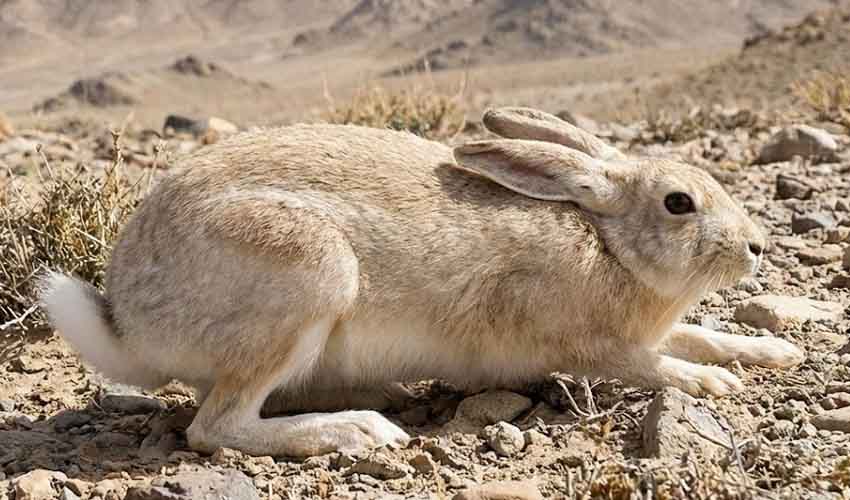
A desert-and-oasis specialist built for life on the dry margins of Central Asia, especially around river valleys and scattered green patches where plants can survive. It has the classic hare shape—slim body, long hind legs for sudden bursts, and large ears that swivel like little satellite dishes—but its overall look is tuned to dust, sun, and wide-open space. Its coat is usually pale brown to sandy gray, often with a slightly “washed” tone that blends into dry soil and sparse shrubs. The underside is lighter, and the tail can flash pale when it runs. Up close, the fur often looks finely speckled, which helps break up its outline when it crouches in the open.
While lots of hares do well in grassy fields or cool forests, the Yarkand hare is most at home near deserts, semi-deserts, and sandy river basins—places where life clusters around water. It tends to use reed beds, low bushes, and the edges of farmland or oases as cover, then ventures out to feed. Compared with hares in colder northern regions that may grow heavier coats or shift dramatically in color with snow, the Yarkand hare generally keeps a warm, earthy palette that matches sand and sunbaked ground. Its ears are a standout feature in this environment: besides helping it hear danger early, they can also help release heat, which is useful when daytime temperatures climb.
Daily life for a Yarkand hare is a careful balance between feeding and staying out of trouble in a landscape that doesn’t offer many hiding places. It mainly eats plants—grasses, leaves, tender shoots, and whatever green growth it can find near water or seasonal vegetation—switching foods depending on what’s available. It often becomes most active during the cooler hours, like dawn, dusk, and night, when the desert air is less punishing, and movement is safer.
Distribution
 China
ChinaAnything we've missed?
Help us improve this page by suggesting edits. Glory never dies!
Suggest an editGet to know me
Terrestrial / Aquatic
Altricial / Precocial
Polygamous / Monogamous
Dimorphic (size) / Monomorphic
Active: Diurnal / Nocturnal
Social behavior: Solitary / Pack / Herd
Diet: Carnivore / Herbivore / Omnivore / Piscivorous / Insectivore
Migratory: Yes / No
Domesticated: Yes / No
Dangerous: Yes / No




