


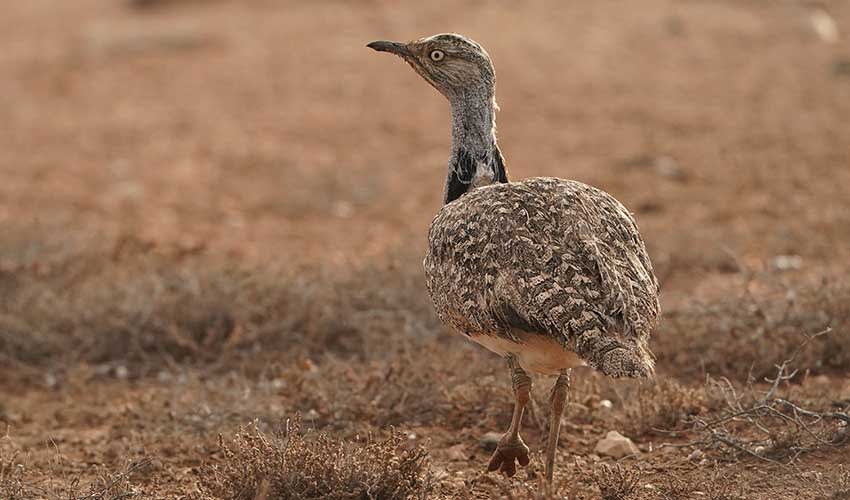
A bird that seems perfectly designed for the wide, sun-baked spaces of North Africa. It lives in deserts and semi-deserts, where the land is open, the plants are low, and the air often shimmers with heat. Instead of bright colors, the African houbara wears a clever mix of sandy browns, pale creams, and fine markings that match the ground so well it can be almost impossible to see when it stands still. This camouflage is one of its greatest strengths, because in a landscape with few trees or tall bushes, staying unnoticed can matter more than being fast.
Most of the time, the African houbara is a quiet, cautious walker. It spends much of its day moving across the land on long legs, pausing often to scan the horizon. It can fly, but it doesn’t waste energy doing so unless it has to. When alarmed, it may first try to slip away on foot, keeping low and moving with surprising speed for a large bird. If danger gets too close, it breaks into a run and then lifts off with strong wingbeats, usually flying low and straight until it can drop back into cover. This “walk first, fly last” approach helps it save energy and water in an environment where both are precious.
The African houbara’s diet is another reason it can handle harsh conditions. It eats a wide variety of foods, including insects, small creatures, seeds, shoots, and other plant matter. That flexibility is like having a backup plan for every season. After rains—when deserts briefly burst with life—food can suddenly become more abundant, especially insects, and the houbara takes full advantage. During drier periods, it shifts to whatever plants and seeds are available. It also gets much of its moisture from food, which is a useful trick in places where water can be scarce or far apart.
Distribution
 Algeria
 Egypt
Egypt Libya
Libya Malta
Malta Mauritania
 Morocco
 Spain
Spain Sudan
Sudan Tunisia
Anything we've missed?
Help us improve this page by suggesting edits. Glory never dies!
Suggest an editGet to know me
Terrestrial / Aquatic
Altricial / Precocial
Polygamous / Monogamous
Dimorphic (size) / Monomorphic
Active: Diurnal / Nocturnal
Social behavior: Solitary / Pack / Herd
Diet: Carnivore / Herbivore / Omnivore / Piscivorous / Insectivore
Migratory: Yes / No
Domesticated: Yes / No
Dangerous: Yes / No




