


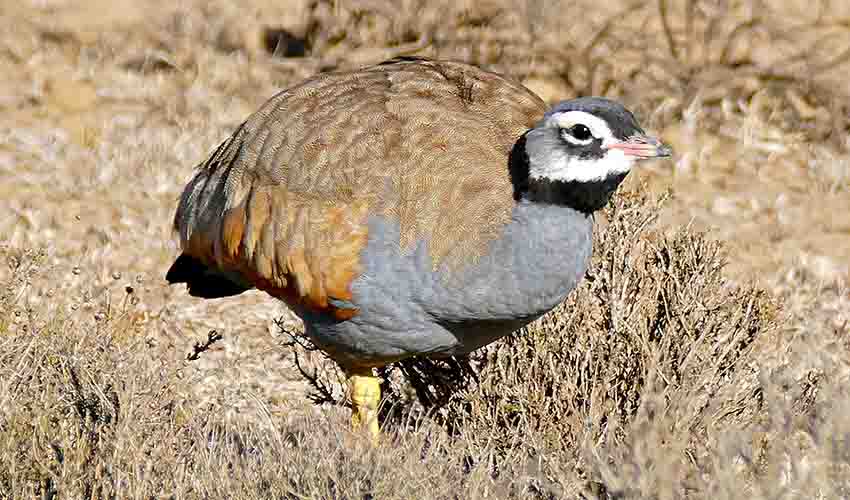
From a distance, it can seem like another grassland bird—until the light hits it right and you notice the male’s cool bluish-gray body tones, set off by darker markings on the head and warmer browns on the back and wings. It has the classic bustard build: strong chest, long legs made for walking, and a watchful head that’s always checking what’s happening around it. This is not a bird that depends on flashy jungle colors or dramatic feather patterns.
Blue bustards are most at home in high, open grasslands and dry shrubby plains, especially places with short grass and wide, flat views. That makes sense, because this species lives by spotting trouble early. It spends much of its day walking with a steady, deliberate pace, pausing often to feed and scan. If something worries it, it doesn’t instantly take to the air as many birds do. Instead, it tends to crouch, walk away, or break into a run—saving flight for the moment it really needs it. When it does take off, it can fly strongly for a good distance, but the launch often looks like an effort: a quick “runway start,” then powerful wingbeats until it’s properly airborne. One of the coolest things about the blue bustard is its voice: rather than a sweet song, it makes a series of throaty, frog-like croaks that are often given while flying, especially around dawn—like a strange, echoing announcement rolling across the grassland.
Food-wise, the blue bustard is practical and flexible. It will eat a mix of insects and other small creatures it can catch on the ground, along with seeds and bits of plants when that’s what’s available. This ability to switch menus helps it cope with grassland life, where good feeding can depend on rainfall, season, and what’s currently growing or crawling.
Distribution
 Lesotho
 South Africa
Anything we've missed?
Help us improve this page by suggesting edits. Glory never dies!
Suggest an editGet to know me
Terrestrial / Aquatic
Altricial / Precocial
Polygamous / Monogamous
Dimorphic (size) / Monomorphic
Active: Diurnal / Nocturnal
Social behavior: Solitary / Pack / Herd
Diet: Carnivore / Herbivore / Omnivore / Piscivorous / Insectivore
Migratory: Yes / No
Domesticated: Yes / No
Dangerous: Yes / No




