


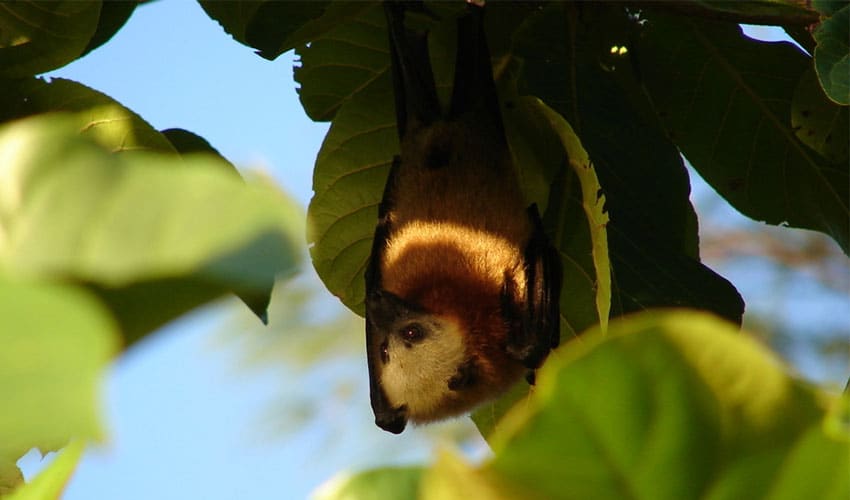
Imagine a fluffy fox with wings: it has a foxy, pointed face with big dark eyes, a thick ruff of yellow-to-orange fur around the neck and shoulders, and long black wings that look like folded leather when it hangs upside down in the trees. Its body is about as long as a pencil case, but its wings can stretch close to a meter across, making it a serious “flying” fox despite its gentle diet.
The fur on its back is darker brown, with some silvery hairs mixed in, while the belly is lighter and softer. When they roost in groups in coconut palms or mangroves, they can look like clusters of strange, upside-down fruit tucked among the leaves.
This bat is a wet-season gardener of Aldabra. Like other flying foxes, it feeds almost entirely on plant material—fruit, flowers, nectar, and leaves. On Aldabra, it has been seen feeding on figs, Indian almonds, Calophyllum trees, grey mangroves, coconut flowers, sisal blossoms, and even licking sugary honeydew left by tiny scale insects on fig leaves. As it chews fruit, it usually squeezes out the juice and soft pulp, then spits out much of the fiber and seeds. Those spat-out bits, plus seeds that pass through its gut, help spread plants around the atoll. In that way, the Aldabra flying fox acts almost like a night-time gardener, carrying seeds between islands and different parts of the reef rim.
It spends the day roosting in trees, often in small, loose groups rather than in huge bat colonies, and becomes active around dusk, when the air cools, and the sky is still bright enough to navigate by.
Distribution
 Seychelles
 Official estimate
Anything we've missed?
Help us improve this page by suggesting edits. Glory never dies!
Suggest an editGet to know me
Terrestrial / Aquatic
Altricial / Precocial
Polygamous / Monogamous
Dimorphic / Monomorphic (size)
Active: Diurnal / Nocturnal
Social behavior: Solitary / Pack / Colony
Diet: Carnivore / Herbivore / Omnivore / Piscivorous / Insectivore
Migratory: Yes / No
Domesticated: Yes / No
Dangerous: Yes / No




