


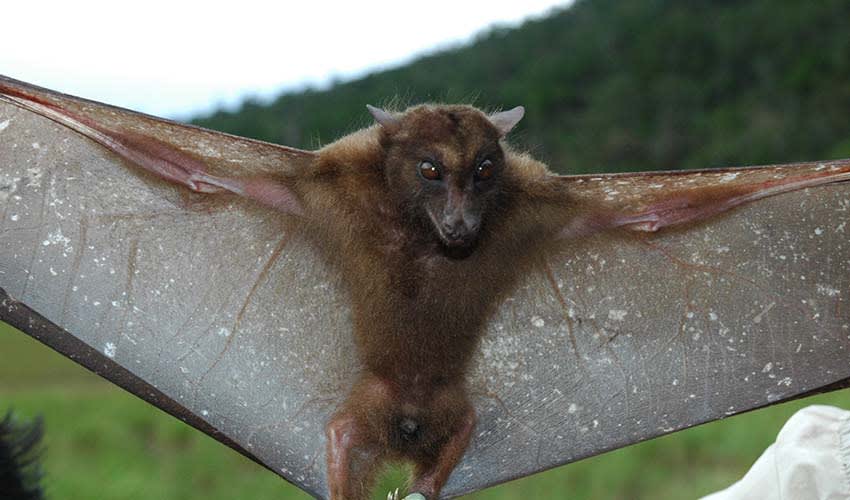
Endemic to the Philippines, this rare species is part of the genus Harpyionycteris, a small group of fruit bats known for their unusually strong jaws, distinctive skulls, and specialized diets. Among the rich diversity of fruit bats in Southeast Asia, the harpy fruit bat stands out for its combination of powerful build, unique facial features, and mysterious lifestyle, earning it a place among the most fascinating creatures of the tropical forest canopy.
Physically, the harpy fruit bat is a medium-sized megabat. It has a robust body covered in dense, soft fur, typically a dark grayish-brown or chocolate brown, with a slightly paler underside. Its face is short and broad, with a strong, doglike muzzle and large, expressive eyes, giving it a rather endearing yet powerful appearance. One of its most striking traits is its short, rounded skull and thick jaw muscles, which enable it to crush tough fruits and seeds that most other bats cannot eat. This specialized anatomy—particularly its uniquely shaped molars and incisors—has earned it the genus name Harpyionycteris, meaning “harpy bat,” a nod to the fierce strength of the mythological harpies.
Unlike many fruit bats that feed mainly on soft fruits such as figs, the harpy fruit bat is a specialist seed eater. It consumes fruits with hard pulp and large seeds, including those from trees that rely on animals for seed dispersal. Its powerful bite allows it to break through fruit husks to reach the nutritious interior, and in doing so, it helps spread and germinate forest seeds, playing a crucial role in maintaining forest diversity. This makes the species an important ecological ally in tropical forest ecosystems, particularly in the Philippines’ mountain regions where it is most often found. These bats are typically nocturnal foragers, leaving their roosts at dusk to feed in the forest canopy before returning to secluded roosting spots before dawn.
Distribution
 Philippines
Anything we've missed?
Help us improve this page by suggesting edits. Glory never dies!
Suggest an editGet to know me
Terrestrial / Aquatic
Altricial / Precocial
Polygamous / Monogamous
Dimorphic (size) / Monomorphic
Active: Diurnal / Nocturnal
Social behavior: Solitary / Pack / Colony
Diet: Carnivore / Frugivore / Omnivore / Piscivorous / Insectivore
Migratory: Yes / No
Domesticated: Yes / No
Dangerous: Yes / No




