


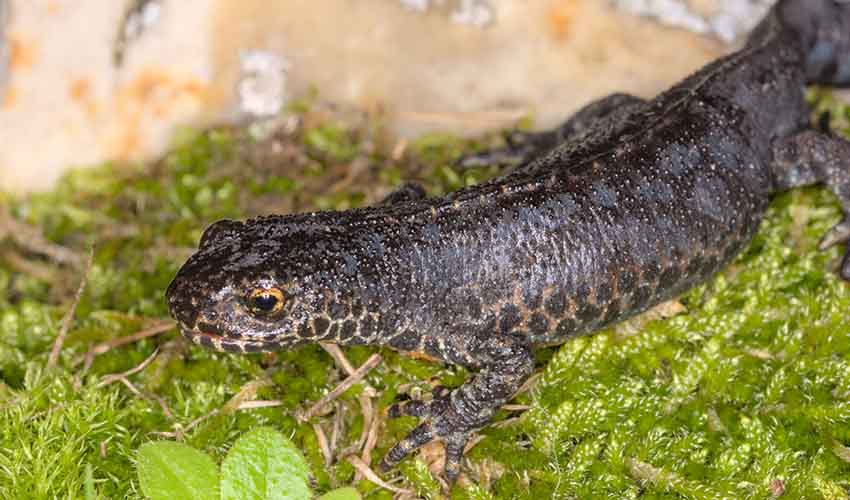
A striking and versatile amphibian native to continental Europe, celebrated for its vivid colors, dual‐habitat lifestyle, and surprising adaptability. In non-breeding times, they display muted grey or brown tones, but come the breeding season, the males transform into shimmering blue-grey dorsal surfaces, a bold white flank stripe often dotted with black, and a brilliant orange belly—creating a vivid contrast that’s hard to forget.
This newt’s life is split between land and water. For much of the year it lives on land—nestled under logs, stones or leaf-litter in forests, meadows or mountain slopes—moving at night and hiding by day. But each spring, it migrates to ponds, quiet pools or slow-flowing waters (typically free of fish) to breed. There, the males perform elaborate courtship dances, waving their tails, displaying their bright flanks, and depositing sperm packets (spermatophores) for females to pick up. The females then wrap each egg individually in a leaf of aquatic vegetation—a marvel of parental care for a seemingly simple creature. The larvae hatch after a few weeks and live in the water for a few months before metamorphosing and heading onto land. Interestingly, in some populations the newts may skip the metamorphosis and remain aquatic in a phenomenon called paedomorphosis.
One of the things that makes the Alpine newt especially intriguing is its adaptability. It occurs from lowland forests right up into alpine zones at over 2 000 meters elevation. It can use both permanent ponds and temporary pools, tolerate a range of water conditions, and its terrestrial phase allows it to exploit forest floor habitats when not breeding. However, despite this resilience, it still faces threats from pollution, habitat loss, introduction of trout or other predatory fish into ponds, and fragmentation of land-water corridors.
Distribution
 Albania
 Austria
 Belgium
 Bosnia And Herz.
 Bulgaria
 Croatia
 Czechia
 Denmark
 France
 Germany
 Greece
 Hungary
 Italy
Italy Liechtenstein
 Luxembourg
 Montenegro
 Netherlands
 North Macedonia
 Poland
 Romania
 Serbia
 Slovakia
 Slovenia
 Spain
Spain Switzerland
 Ukraine
 United Kingdom
Anything we've missed?
Help us improve this page by suggesting edits. Glory never dies!
Suggest an editGet to know me
Terrestrial / Aquatic
Altricial / Precocial
Polygamous / Monogamous
Dimorphic (size) / Monomorphic
Active: Diurnal / Nocturnal
Social behavior: Solitary / Pack / Herd
Diet: Carnivore / Herbivore / Omnivore / Piscivorous / Insectivore
Migratory: Yes / No
Domesticated: Yes / No
Dangerous: Yes / No




