


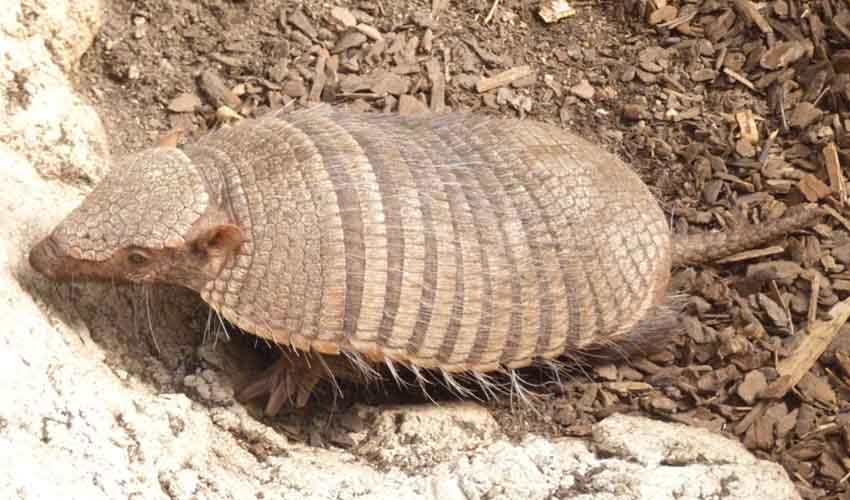
Unlike the sleeker “tank” look many people imagine when they think of armadillos, this species has noticeable tufts of coarse hair poking out between its protective plates and along its sides and belly. That extra hair isn’t just for style: it helps with insulation and may offer a bit of protection against scratches when it pushes through brush or digs. Its body is sturdy and muscular, with strong front legs and heavy claws built for serious excavation. The head is long and narrow, the ears are upright, and the tail is thick—overall, it looks like an animal designed for hard labor in tough landscapes.
The big hairy armadillo is an enthusiastic digger, creating burrows that provide shelter from heat, cold, and predators. It can also turn digging into a quick escape plan—if threatened, it may bolt to a burrow or start digging with surprising speed, throwing soil backward like a tiny construction machine. Compared with armadillos, famous for curling into a ball, this one relies less on “rolling up” and more on armor and burrowing tactics. Its plates still form a strong protective shell, but it doesn’t seal itself into a tight sphere the way three-banded armadillos do. In other words, it’s a builder and bunker user, not a living bowling ball.
Many armadillos are picky specialists—some focus heavily on ants and termites, while others are tied to particular habitats. The big hairy armadillo is more of an all-rounder. It eats insects, grubs, and other small creatures it digs up, but it may also snack on plant matter when available. This flexible menu helps it cope with changing seasons and unpredictable food supplies. It also tends to be most active when it’s cooler—often at night or during the early morning—making it a quiet, hard-to-spot neighbor that does most of its business when the world is calmer.
Distribution
 Argentina
 Bolivia
 Chile
Chile Paraguay
Anything we've missed?
Help us improve this page by suggesting edits. Glory never dies!
Suggest an editGet to know me
Terrestrial / Aquatic
Altricial / Precocial
Polygamous / Monogamous
Dimorphic (size) / Monomorphic
Active: Diurnal / Nocturnal
Social behavior: Solitary / Pack / Herd
Diet: Carnivore / Herbivore / Omnivore / Piscivorous / Insectivore
Migratory: Yes / No
Domesticated: Yes / No
Dangerous: Yes / No




