


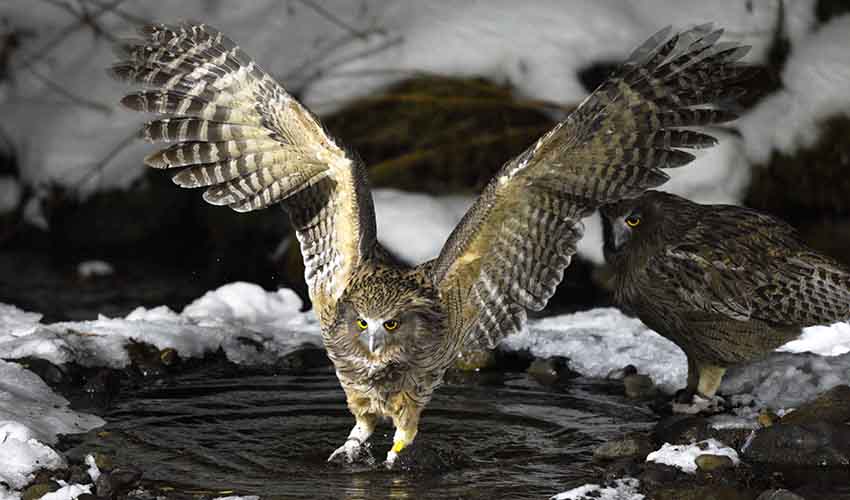
Found in parts of eastern Asia, particularly in remote river valleys and old-growth forests, this owl is immediately recognizable by its massive size, broad wings, and powerful build. Its shaggy, brown-and-cream feathers give it a rugged, almost wild appearance, while its bright yellow eyes seem constantly alert. Unlike many owls with smooth facial disks, Blakiston’s fish owl has a looser, less defined face, which adds to its distinctive look and sets it apart from its relatives.
What truly distinguishes Blakiston’s fish owl from most other owls is its lifestyle and diet. As its name suggests, this owl specializes in catching fish, something only a few owl species in the world regularly do. It hunts along rivers, streams, and lakes, often perching quietly on a branch or rock near the water’s edge. Instead of swooping through the air, it may drop directly onto prey or even wade into shallow water using its long, powerful legs. Compared to other owls that rely mainly on small mammals, this fish-based diet makes it unique and closely tied to clean, healthy waterways.
Blakiston’s fish owl is also known for its strong attachment to old forests. It depends on large, ancient trees with wide cavities for nesting, which means it cannot easily adapt to areas where forests have been heavily altered. During the day, it roosts quietly in dense woodland, blending into the shadows. At night, it becomes active, flying with surprisingly silent wingbeats despite its enormous size. Its call is deep and booming, often described as echoing like a distant horn through the forest, adding to its powerful presence.
Distribution
 China
China Japan
Japan North Korea
 Russia
Anything we've missed?
Help us improve this page by suggesting edits. Glory never dies!
Suggest an editGet to know me
Terrestrial / Aquatic
Altricial / Precocial
Polygamous / Monogamous
Dimorphic (size) / Monomorphic
Active: Diurnal / Nocturnal
Social behavior: Solitary / Pack / Herd
Diet: Carnivore / Herbivore / Omnivore / Piscivorous / Insectivore
Migratory: Yes / No
Domesticated: Yes / No
Dangerous: Yes / No




