


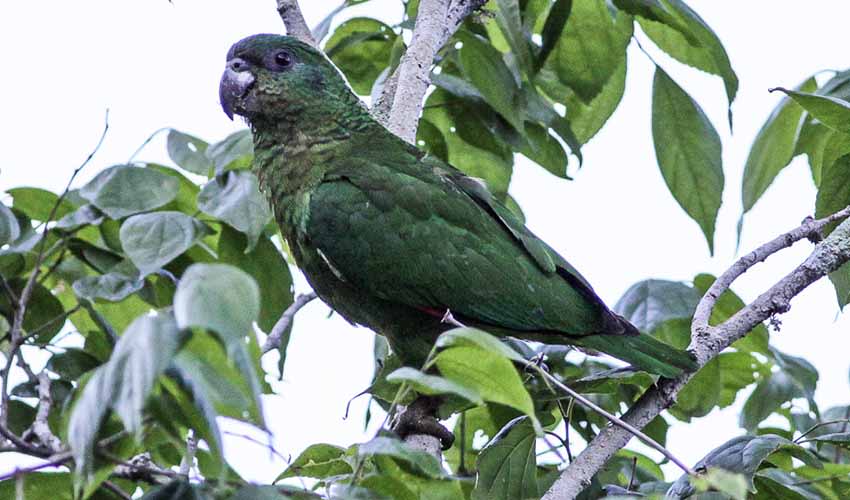
A distinctive and charming parrot found only on the island of Jamaica, where it lives among forests, woodlands, and mountainous regions. It gets its name from its dark, almost black bill, which contrasts with its mostly green feathers. Subtle touches of blue, purple, and pink can be seen on its face and throat, especially in good light, giving the bird a soft yet colorful appearance. Medium-sized and sturdy, the black-billed amazon has strong wings for steady flight and alert eyes that reflect its intelligence and curiosity. Its calls are loud and expressive, often heard echoing through the trees long before the bird comes into view.
This parrot is well adapted to a variety of habitats, from lowland forests to higher mountain areas. It feeds mainly on fruits, seeds, berries, and flowers, helping spread seeds across its environment. The black-billed amazon often forages in small groups or pairs, moving methodically through the canopy as it searches for food. While it can be cautious and quiet when feeding, it becomes far more vocal during flight, calling back and forth to keep contact with flock members. Its strong bill allows it to handle tough fruit skins and seeds that many other birds cannot manage.
Social behavior is an important part of the black-billed amazon’s life. These parrots form strong pair bonds, and mated pairs often remain together for many years. They are frequently seen sitting close to one another, preening and sharing food. During the breeding season, they nest in natural cavities in trees, often high above the ground. Both parents take part in caring for the young, with one guarding the nest while the other searches for food. Young parrots stay with their parents for a long time, learning feeding habits and safe routes through the forest.
Distribution
 Jamaica
 Official estimate
Anything we've missed?
Help us improve this page by suggesting edits. Glory never dies!
Suggest an editGet to know me
Terrestrial / Aquatic
Altricial / Precocial
Polygamous / Monogamous
Dimorphic (size) / Monomorphic
Active: Diurnal / Nocturnal
Social behavior: Solitary / Pack / Flock
Diet: Carnivore / Frugivore / Omnivore / Piscivorous / Insectivore
Migratory: Yes / No
Domesticated: Yes / No
Dangerous: Yes / No




