


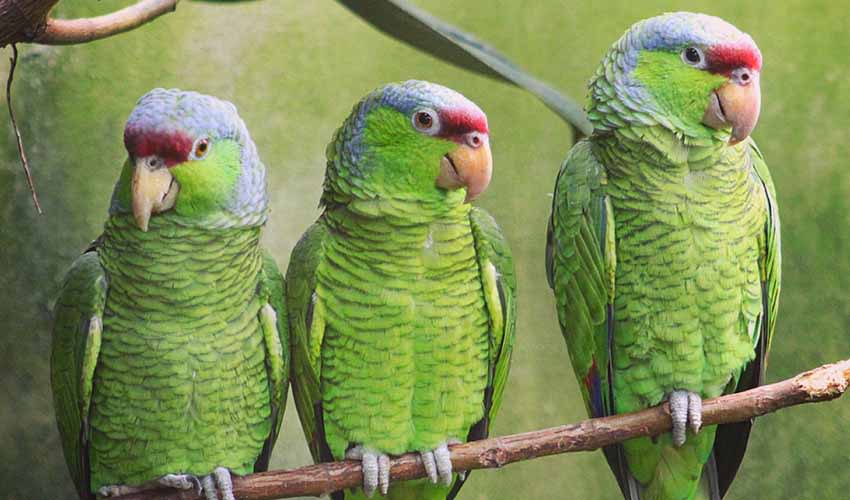
A medium-sized green parrot with a look that’s both subtle and unmistakable once you know what to watch for. Its signature feature is the soft purple-gray “lilac” wash on the top of the head, paired with a pale forehead and a bold red patch at the base of the upper beak. The eyes are often bright and expressive, and the beak is a light horn color that stands out against its green face. In the wild, it’s most closely tied to the drier forests and foothills along the Pacific side of Mexico, where it moves through treetops in pairs or small groups, calling to each other with sharp, far-carrying voices.
Many amazons are mostly green with splashes of color, but this species’ lilac crown and red lores (that red patch by the beak) create a unique, slightly masked expression. It can be confused with other Pacific-slope amazons at a glance, especially in quick fly-bys, but the lilac tint on the crown is the tell that birders look for—less like a bright cap and more like someone dusted the head with a soft purple chalk. It also differs in overall vibe: it’s often associated with drier, more seasonal habitats than some rainforest-loving parrots, and it tends to rely on fruiting trees that can be scattered and unpredictable. That means it may travel locally to follow food, showing up loudly in an area for a while and then seeming to disappear when the season shifts.
In daily life, the lilac-crowned amazon is a social, curious eater and an expert tree climber. It feeds on fruits, seeds, nuts, blossoms, and buds—basically a rotating “forest buffet”—and it uses its beak like a third hand to steady itself while it climbs. Watching an Amazon eat is half comedy, half skill: it holds food with one foot, nibbles with careful precision, and occasionally pauses to look around like it’s checking whether anyone is judging its table manners.
Distribution
 Mexico
 Official estimate
Anything we've missed?
Help us improve this page by suggesting edits. Glory never dies!
Suggest an editGet to know me
Terrestrial / Aquatic
Altricial / Precocial
Polygamous / Monogamous
Dimorphic (size) / Monomorphic
Active: Diurnal / Nocturnal
Social behavior: Solitary / Pack / Herd
Diet: Carnivore / Herbivore / Omnivore / Piscivorous / Insectivore
Migratory: Yes / No
Domesticated: Yes / No
Dangerous: Yes / No




