


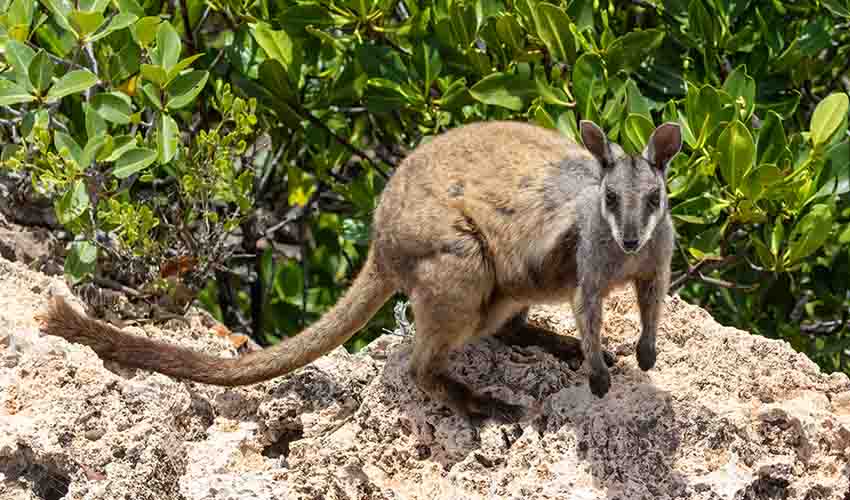
A cliff-dwelling wallaby from northern Australia that looks like it was designed for life on rugged stone. It lives among steep slopes, rocky outcrops, and boulder piles—places where the ground turns into a maze of ledges and cracks. Like other rock-wallabies, it’s compact and athletic, with powerful back legs for springy leaps and a long tail that acts like a balancing pole when it lands on uneven rock. Its overall coloring is usually earthy—browns and grays that match sunbaked stone—but the feature that really gives it character is the darker shading along its sides: those “black flanks” create a bold contrast that can be surprisingly useful in broken light and shadow.
What sets the black-flanked rock-wallaby apart from other rock-wallabies is its dramatic side patterning and its strong tie to specific rocky regions in the tropical north. Rock-wallabies can be confusingly similar at a glance, so a clean, consistent marking—like a noticeably dark band along the flanks—helps distinguish it from relatives that have brighter stripes, paler sides, or more speckled coats. The darker flanks can make the body look slimmer and more shadow-shaped, which is handy when you’re trying to blend into cliff faces that are full of dark seams and shaded cracks. In other words, it’s not “plain brown wallaby number seven”—it has a signature look that fits the rock-and-shadow world it inhabits, and that look is part of how it stays hard to spot.
Daily life for a black-flanked rock-wallaby is all about timing and terrain. During the heat of the day, it often rests in cool crevices, caves, and overhangs where the temperature can feel dramatically lower than the open hillside. When the sun drops and the air cools, it comes out to feed on grasses, leaves, and shrubs, usually staying close to the safety of rocks. That way, if danger appears, it doesn’t need to win a race across open ground—it just needs to reach the nearest boulder field and let the landscape do the work.
Distribution
 Australia
 Official estimate
Anything we've missed?
Help us improve this page by suggesting edits. Glory never dies!
Suggest an editGet to know me
Terrestrial / Aquatic
Altricial / Precocial
Polygamous / Monogamous
Dimorphic (size) / Monomorphic
Active: Diurnal / Nocturnal
Social behavior: Solitary / Pack / Herd
Diet: Carnivore / Herbivore / Omnivore / Piscivorous / Insectivore
Migratory: Yes / No
Domesticated: Yes / No
Dangerous: Yes / No




