


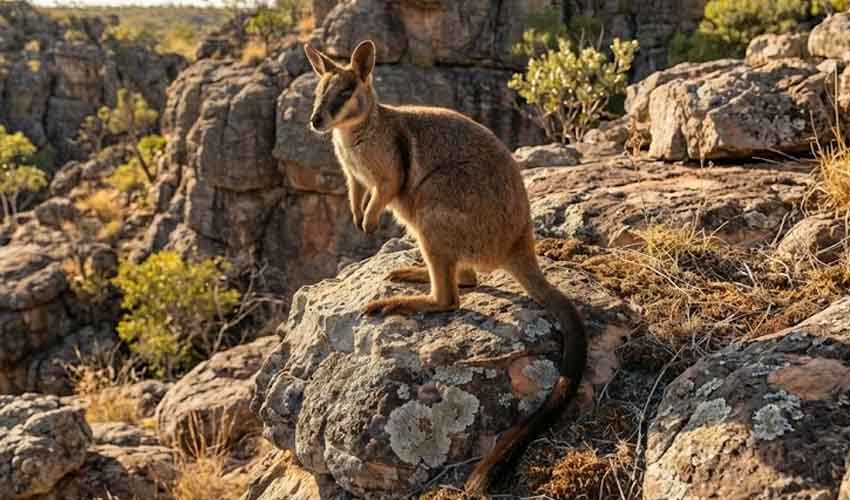
Often described as rabbit-sized, it’s one of the smallest members of the kangaroo-and-wallaby family, with a compact body, delicate face, and a quick, springy way of moving that makes it look like a little bundle of muscle and nerves. It lives in rugged, stony country—rocky escarpments, boulder fields, and cliffy slopes—especially across parts of the Northern Territory and the Kimberley region of Western Australia.
Many rock-wallabies are medium-sized and sturdy, built for repeated leaps across ledges. The nabarlek does that too, but in miniature, and its small frame helps it use hiding places that would be useless to larger animals. Its coat is usually a warm reddish-brown to gray-brown, often with paler underparts, and its face can show fine markings that break up its outline in patchy light. Compared with similar wallabies, it tends to look more delicate and light-limbed, built for quick bursts and sudden changes of direction rather than long travel. It also has a strong attachment to rocky shelters, often choosing areas with plenty of crevices and caves where it can rest safely during the day.
A nabarlek’s daily routine is shaped by heat and danger. During daylight hours, it usually stays hidden in cool rocky hollows, where the temperature can be noticeably lower than the sun-baked ground outside. After dusk, it comes out to feed, nibbling on grasses, herbs, and leaves from shrubs growing among the rocks and nearby open patches. Like many wallabies, it needs to balance food and safety: the best feeding spots can be more exposed, so it often stays close to cover and keeps a sharp sense of what’s happening around it. When threatened, it doesn’t try to outfight anything—it relies on speed, agility, and the landscape. One sharp hop into the right crack between boulders can end a chase instantly.
Distribution
 Australia
 Official estimate
Anything we've missed?
Help us improve this page by suggesting edits. Glory never dies!
Suggest an editGet to know me
Terrestrial / Aquatic
Altricial / Precocial
Polygamous / Monogamous
Dimorphic (size)/ Monomorphic
Active: Diurnal / Nocturnal
Social behavior: Solitary / Pack / Herd
Diet: Carnivore / Herbivore / Omnivore / Piscivorous / Insectivore
Migratory: Yes / No
Domesticated: Yes / No
Dangerous: Yes / No




