


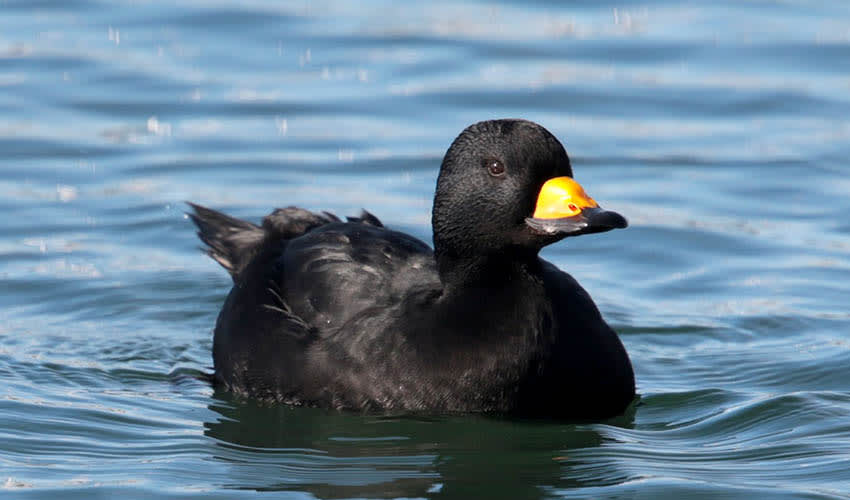
A tough, sea-going duck that brings a touch of drama to cold coastlines with its simple but striking look. Adult males are almost entirely velvety black, broken only by a bright, swollen patch of yellow-orange at the base of the bill—like a little glowing beacon on a dark bird. Females and young birds are much softer in tone: chocolate-brown with paler cheeks and throat, giving them a gentle, slightly “soft-faced” appearance.
Like other scoters, the black scoter is a true sea duck, closely tied to cold coastal waters for much of the year. In winter, you’ll often find them just beyond the breaking waves, in loose lines or dense rafts that dive in rolling patterns: one group disappears, another pops up. They are diving specialists, plunging under the surface to pry small mussels, clams, and other shellfish from the sea floor. They swallow their prey whole and crush the shells in a strong gizzard—no need to crack anything open by hand. This shellfish diet means they favor coastlines with rich, shallow feeding areas: sandy bays, sheltered estuaries, and rocky shores where underwater life thrives. On calm days, a scope reveals them busily feeding; on rough days, they simply ride the swells, disappearing in troughs and reappearing on crests with impressive balance.
The annual life cycle of the black scoter draws a long loop between wild northern breeding grounds and more temperate coasts. They nest on freshwater lakes and ponds across the far north—tundra pools in Alaska and northern Canada, boggy lakes in Siberia, and remote taiga wetlands. In summer, it can be surprising to see this sea duck sitting on a quiet inland pond, but this is where pairs form, and the real family work happens.
Distribution
 Canada
 China
China Japan
Japan Korea
Korea Mexico
 North Korea
 Russia
 Saint Pierre
 United States
Anything we've missed?
Help us improve this page by suggesting edits. Glory never dies!
Suggest an editGet to know me
Terrestrial / Aquatic
Altricial / Precocial
Polygamous / Monogamous
Dimorphic (size) / Monomorphic
Active: Diurnal / Nocturnal
Social behavior: Solitary / Pack / Herd
Diet: Carnivore / Herbivore / Omnivore / Piscivorous / Insectivore
Migratory: Yes / No
Domesticated: Yes / No
Dangerous: Yes / No




