


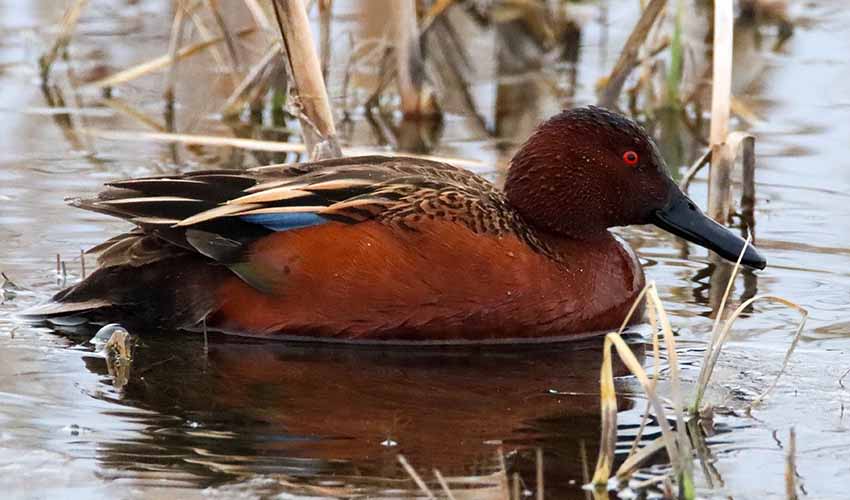
One of the most eye-catching ducks in the Americas, instantly recognizable thanks to the rich reddish-brown plumage of the adult male. In bright light, a male looks almost glowing—deep cinnamon body and head, dark bill, and striking red eyes that give him an intense, almost ember-like expression. This bold color makes the species stand out among other dabbling ducks, most of which are patterned in browns and grays.
Females, by contrast, are much more camouflaged, dressed in mottled brown feathers that help them blend into marsh vegetation. Their appearance is famously similar to that of female blue-winged Teal, but experienced observers note that female cinnamon teal are slightly warmer-toned, longer-billed, and often more uniformly mottled. Even with these differences, teasing them apart can be a satisfying identification challenge for birdwatchers.
Unlike many duck species that stay on a single continent or follow a simple north–south migration pattern, the cinnamon teal is spread across both North and South America. In western North America, the species breeds from interior British Columbia and the western United States into parts of the Great Basin and Rocky Mountain regions. These northern birds then migrate southward to winter mainly in Mexico, Central America, and northern South America.
Further south, several subspecies live year-round in areas such as the Andes, Patagonia, and the temperate lowlands of South America. This unusual distribution means that cinnamon teal can be found from high Andean wetlands to warm lowland marshes, making them one of the continent’s most flexible small ducks. Their presence across so many climates and elevations is a testament to their adaptability.
Their habitat choices revolve around the needs of a dabbling duck: shallow, productive wetlands with plenty of plants and invertebrates. Cinnamon teal favor marshes, ponds, lake edges, and slow-moving streams with dense emergent vegetation like cattails and sedges. These plants provide cover for nesting females and a buffet of seeds and aquatic insects for foraging adults.
Distribution
 Antigua & Barbuda
 Argentina
 Aruba
Aruba Bahamas
 Belize
 Bolivia
 Brazil
 Canada
 Cayman Islands
 Chile
Chile Colombia
 Costa Rica
 Cuba
Cuba Ecuador
 El Salvador
 Falkland Islands
 Guatemala
 Honduras
 Jamaica
 Mexico
 Nicaragua
 Panama
 Paraguay
 Peru
Peru Puerto Rico
 Turks & Caicos
 US Virgin Islands
 United States
 Uruguay
 Venezuela
Anything we've missed?
Help us improve this page by suggesting edits. Glory never dies!
Suggest an editGet to know me
Terrestrial / Aquatic
Altricial / Precocial
Polygamous / Monogamous
Dimorphic (size) / Monomorphic
Active: Diurnal / Nocturnal
Social behavior: Solitary / Pack / Herd
Diet: Carnivore / Herbivore / Omnivore / Piscivorous / Insectivore
Migratory: Yes / No
Domesticated: Yes / No
Dangerous: Yes / No




