


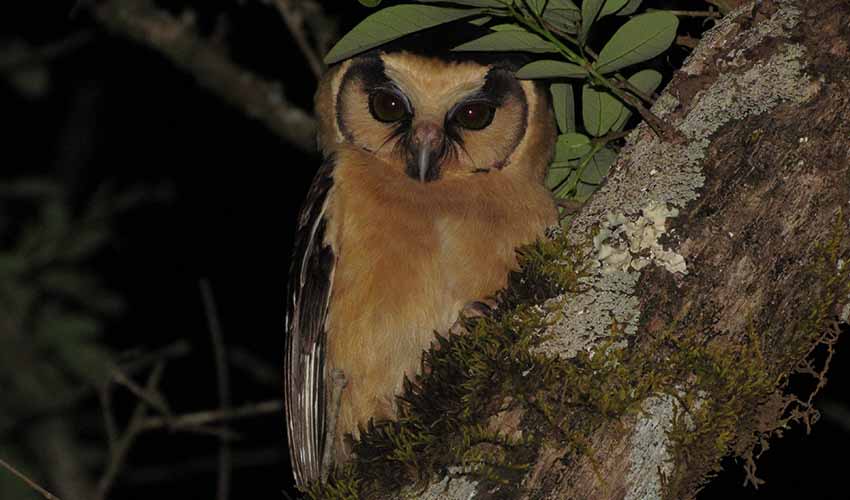
A small and little-known owl found in parts of South America, where it lives quietly in forested and wooded regions. Despite its modest size, it has a striking and memorable appearance. As its name suggests, it has a warm buff-colored patch on its forehead that contrasts with its darker brown and gray feathers. Its large yellow eyes stand out against its face, giving it an alert, almost curious expression. Because of its excellent camouflage and shy behavior, the buff-fronted owl is rarely seen, even by experienced birdwatchers.
One of the most distinctive features of the buff-fronted owl is its preference for dense, undisturbed forests. Unlike owls that adapt easily to human-altered landscapes, this species tends to remain in natural woodland, where it can roost quietly during the day. It often perches close to tree trunks or within thick foliage, relying on stillness rather than flight to avoid detection. At night, it becomes active, gliding silently through the forest as it searches for food. Compared to more vocal owls, the buff-fronted owl is relatively quiet, which adds to its mysterious reputation.
The buff-fronted owl is a skilled hunter that feeds mainly on insects, small mammals, and other small animals. It hunts from low perches, watching carefully before making a swift, direct strike. Its sharp hearing and keen eyesight allow it to detect movement even in dim light. Because of its size, it depends on speed and precision rather than strength. This hunting style helps it thrive in cluttered forest environments where quick reactions are essential.
Distribution
 Argentina
 Bolivia
 Brazil
 Colombia
 Ecuador
 Paraguay
 Peru
Peru Uruguay
 Venezuela
Anything we've missed?
Help us improve this page by suggesting edits. Glory never dies!
Suggest an editGet to know me
Terrestrial / Aquatic
Altricial / Precocial
Polygamous / Monogamous
Dimorphic (size) / Monomorphic
Active: Diurnal / Nocturnal
Social behavior: Solitary / Pack / Herd
Diet: Carnivore / Herbivore / Omnivore / Piscivorous / Insectivore
Migratory: Yes / No
Domesticated: Yes / No
Dangerous: Yes / No




