


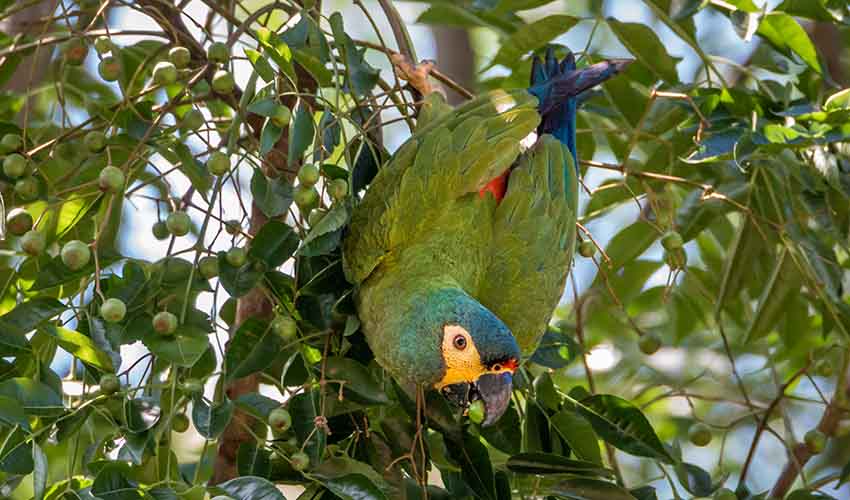
A striking and energetic parrot found mainly in the open forests, savannas, and woodland edges of central South America. It is medium-sized for a macaw, with a slim build, long tail, and broad wings that allow it to fly swiftly across open landscapes. Its most noticeable feature is the bright blue coloring on its wings and tail, which contrasts beautifully with its mostly green body. When in flight, flashes of blue and green make it easy to spot against the sky, giving the bird a lively and elegant appearance.
One of the most distinctive characteristics of the blue-winged macaw is its adaptability. Unlike many larger macaws that depend heavily on dense rainforests, this species is comfortable in more open habitats, including palm groves, river edges, and lightly wooded grasslands. It often feeds on seeds, fruits, nuts, and palm fruits, using its strong, curved beak to break open hard shells. This flexible diet allows it to survive in areas where food sources change with the seasons. It is commonly seen flying long distances between feeding and resting sites, showing strong endurance and efficient flight.
The blue-winged macaw is a highly social bird. It is often found in pairs or small groups, and larger gatherings may form at feeding areas or roosting sites. These macaws communicate constantly through loud, sharp calls that help them stay connected while flying or moving through trees. Their voices carry far across open landscapes, making them easier to hear than to see. Pairs usually form strong bonds and can remain together for many years, often flying side by side with synchronized wingbeats.
Distribution
 Argentina
 Brazil
 Paraguay
Anything we've missed?
Help us improve this page by suggesting edits. Glory never dies!
Suggest an editGet to know me
Terrestrial / Aquatic
Altricial / Precocial
Polygamous / Monogamous
Dimorphic (size) / Monomorphic
Active: Diurnal / Nocturnal
Social behavior: Solitary / Pack / Flock
Diet: Carnivore / Frugivore / Omnivore / Piscivorous / Insectivore
Migratory: Yes / No
Domesticated: Yes / No
Dangerous: Yes / No




